

Chapter 4: Strong, vibrant and healthy communities
Chapter 4: Contents
- Housing completions
- Housing delivery on allocated sites
- Changes of use
- Student accommodation completions
- Care home completions
- Other communal accommodation completions
- Housing permissions
- Affordable housing permissions
- Employer-linked affordable housing permissions
- Permissions resulting in loss of dwellings (C3)
- Self-build and community-led housing permissions
- Student accommodation permissions
- Older persons and specialist and supported living accommodation permissions
- Housing land supply
- Cultural and community facilities
- Assets of community value
Housing completions
4.1. In the 2024/2025 monitoring year, 272 (net) dwellings were completed in Oxford. The cumulative number of dwellings completed in the 9 years since the start of the Local Plan period (2016/17 to 2024/25) is 4417 dwellings (net) with the application of ratios for communal accommodation (student, care and other communal accommodation completions) (Table 10).
|
Year |
Market Dwellings Completed |
Affordable Dwellings Completed |
Student Rooms Completed (Number of Equivalent ‘dwellings’) - See table 15 for details |
Care Home Rooms Completed (Number of equivalent ‘dwellings’)
|
Other communal accommodation Completed (Number of equivalent ‘dwellings’)
|
Total dwellings completed (net) |
|---|---|---|---|---|---|---|
|
2016/17 |
284 |
20 |
295 (118) |
-6 (-3) |
n/a |
419 |
|
2017/18 |
170 |
17 |
452 (180) |
0(0) |
n/a |
367 |
|
2018/19 |
158 |
105 |
187 (75) |
36 (20) |
n/a |
358 |
|
2019/20 |
118 |
104 |
1337 (535) |
59 (33) |
n/a |
790 |
|
2020/21 |
322 |
144 |
628 (251) |
-11 (-6) |
n/a |
711 |
|
2021/22 |
243 |
274 |
131 (52) |
-13 (-7) |
34 (19) |
581 |
|
2022/23 |
142 |
273 |
266 (107) |
0 (0) |
57 (32) |
554 |
|
2023/24 |
280 |
61 |
84 (34) |
0 (0) |
-18 (-10) |
365 |
| 2024/25 | 174 | 75 | 55 (23) | 0 (0) | 0 (0) | 272 |
| Total: | 1891 | 1073 | 3435 (1375) | 65 (37) | 73 (41) | 4417 |
4.2. The completed 4,417 dwellings is lower than the 4,643 dwellings (net) projected to be completed by 2024/25 in the Local Plan’s housing trajectory. Figure 6 shows the Local Plan housing requirement (based on the stepped trajectory of 475 dwellings per annum between 2016/17 to 2020/21, and 567 dwellings per annum between 2021/22 to 2035/36) and the standard method housing requirement (which is required by the NPPF to be applied from 2025 onwards and supersedes the Local Plan 2036 annual requirement) compared to completions and projections.
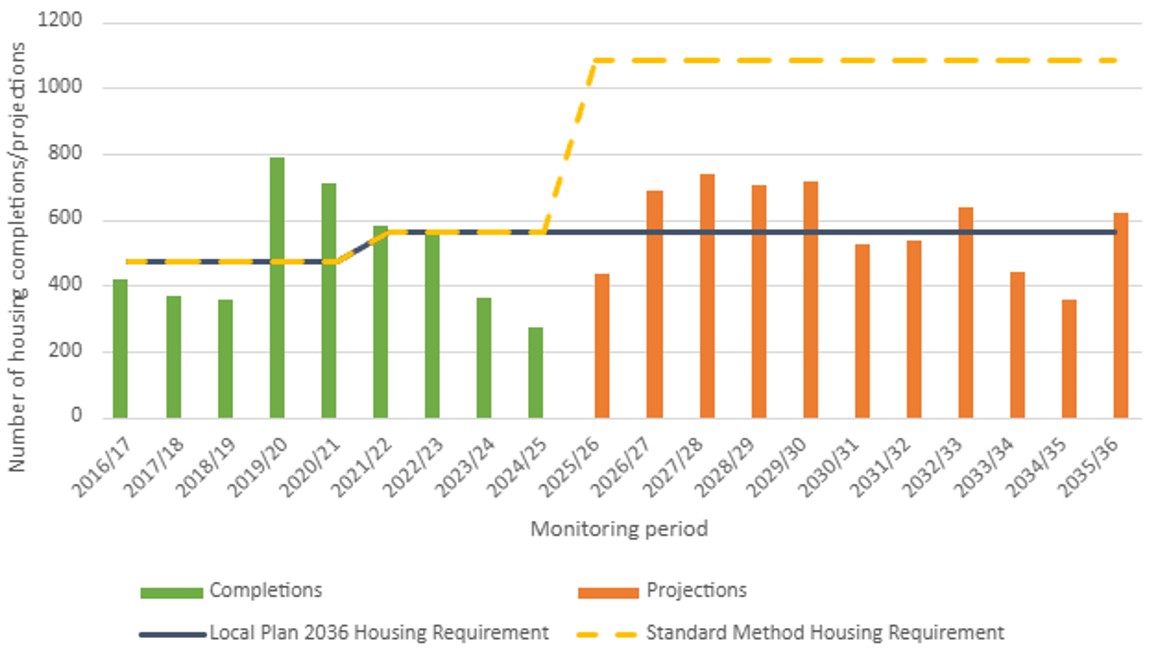
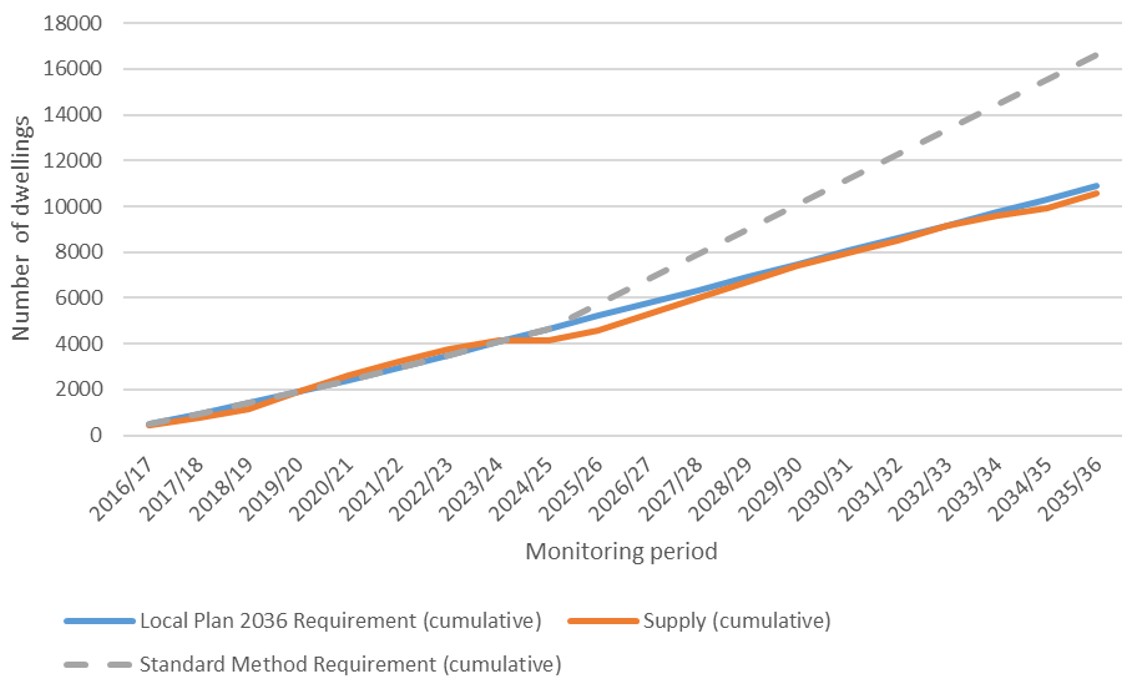
4.3. Figure 7 provides the same information expressed as a comparison between both the Local Plan 2036 and Standard Method cumulative requirement and cumulative supply over the Local Plan period. From 2025/26 onwards these are projected numbers.
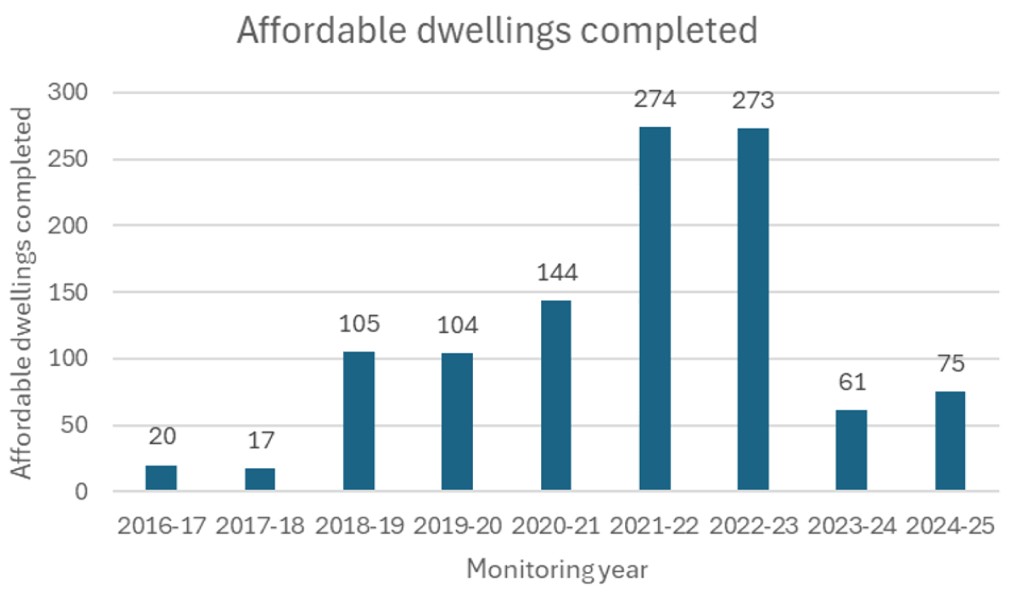
4.4. Table 10 shows that of the 272 total completions in 2024/25, 75 were affordable dwellings. Table 11 shows a breakdown of the sites that delivered affordable housing during the monitoring year including the affordable tenure:
| Site Location | Planning application reference | No. of affordable homes permitted on the site and tenure split | No. of affordable homes completed in 2024/25 and tenure |
|---|---|---|---|
| Barton Park Phase 3 | 19/00518/RES |
83 of 207 (40% affordable) |
18, all social rent |
| Barton Park Phase 4 | 21/02776/RES |
154 of 313 (49% affordable) |
34, all social rent |
| St Frideswide Farm | 21/01449/FUL | 67 of 134 (50%) 56 social rent, 11 shared ownership |
13, all social rent |
| Former Workshop At Lanham Way Oxford Oxfordshire OX4 4PU (Youngs Way) | 21/03114/CT3 | 10 of 10 (100% affordable) 5 social rent, 5 shared ownership |
10, 5 social rent, 5 shared ownership |
Since the start of the Local Plan period (2016/17) there have been a total of 1073 affordable homes built (Figure 8).
4.5. The Council is committed to delivering more affordable housing in Oxford and has been identifying land in its ownership capable of delivering affordable homes and bringing this forward wherever possible. Of the 75 affordable dwellings completed in 2024/25, 62 were delivered on City Council land as set out in Table 12:
| City Council owned site | Planning application reference | No. of homes for social rent completed | No. of homes for intermediate homes completed | No. of homes for shared ownership completed | otal No. of affordable homes completed |
|---|---|---|---|---|---|
| Barton Park Phase 3 | 19/00518/RES | 18 | 0 | 0 | 18 |
| Barton Park Phase 4 | 21/02776/RES | 34 | 0 | 0 | 34 |
| Former Workshop At Lanham Way Oxford Oxfordshire OX4 4PU (Youngs Way) | 21/03114/CT3 | 5 | 0 | 5 | 10 |
Housing delivery on allocated sites
4.6. Since the start of the Local Plan period (2016/17), 9 allocated sites have recorded completions. For the 2024/25 monitoring period, 52 completions on allocated sites were recorded. Allocated sites play a small role relative to the total 272 completions that have occurred this year.
| OLP2036 Site Allocation (SP no.) | Site Name | Planning status |
19/20 total | 20/21 total | 21/22 total | 22/23 total | 23/24 total |
24/25 total | Completions recorded to date |
|---|---|---|---|---|---|---|---|---|---|
| SP19 | Churchill Hospital | Completed | 0 | 0 | 19 | 32 | n/a | n/a | 51 |
| SP24 | St Frideswide Farm | Under construction | 0 | 0 | 0 | 0 | 11 | 26 | 37 |
| SP30 | St Catherines College Manor Road | Completed | 31 | 0 | 0 | 0 | n/a | 0 | 31 |
| SP34 | Court Place Gardens, Iffley | Completed | 0 | 0 | 0 | 0 | 35 | n/a | 35 |
| SP41 | John Radcliffe Hospital Site | Under construction | 0 | 0 | 0 | 0 | 30 | 0 | 30* |
| SP44 | Littlemore Park, Armstrong Road (Newman Place) | Completed | 0 | 0 | 88 | 178 | 7 | n/a | 273 |
| SP47 | Former Nielsen House Conversion | Completed | 0 | 134 | 0 | 0 | n/a | n/a | 134 |
| SP64 | William Morris Close Sports Ground | Completed | 0 | 0 | 86 | 0 | n/a | n/a | 86 |
| SP17 | Headington Hill and Clive Booth | Under construction | 0 | 0 | 0 | 0 | 0 | 26 | 26 |
(n.b. there were no completions on site allocations between 2016 – 2019).
n.b. The John Radcliffe Hospital Site contains key worker housing, some of which is considered communal accommodation, so a dwelling equivalent ratio is included within the completion figure.
Changes of use
4.7. Of the 272 dwellings completed during the 2024/25 monitoring year, 7 dwellings were delivered through the change of use of existing buildings from non-residential to C3 residential. These change of use applications are set out in the table below (Table 14).
| Planning application reference | Type of Change of Use | No. And Tenure completed (net) |
|---|---|---|
| 21/01992/B56 | COU from Offices E(g)(i)) to C3 | 3 market |
| 23/01714/FUL | COU from A1 to C3 | 1 market |
| 20/01259/B56 | COU from B1a to C3 | 2 market |
| 24/01278/EC56 | COU from E to C3 | 1 market |
4.8. All dwellings delivered through changes of use from non-residential to residential in 2024/25 were market housing. Of the four applications, one required planning permission (23/01714/FUL), with the remaining three submitting an application for a prior approval.
Student accommodation completions
4.10. As per Planning Practice Guidance (see Housing supply and delivery on GOV.UK), student accommodation can be counted in housing land supply figures. In the 2024/25 monitoring year 55 (net) units of student accommodation were completed in Oxford (62 rooms (net) at Headington Hill and Clive Booth Student Village and the loss of 7 rooms at Trinity College) Using the ratio of 2.4:1 (as set out in Paragraph 10 of the Housing Delivery Test Measurement Rule Book on GOV.UK) the 55 (net) units of student accommodation equated to 23 C3 equivalent dwellings to Oxford’s housing market (Table 15). This 23 ‘equivalent dwellings’ figure is included within the 272 total dwellings figure shown in Table 10 above.
| Monitoring Year | Number of student rooms completed | Ratio Applied | Number of equivalent ‘dwellings’ |
|---|---|---|---|
| 2016/17 | 295 | 2.5:1 | 118 |
| 2017/18 | 452 | 2.5:1 | 180 |
| 2018/19 | 187 | 2.5:1 | 75 |
| 2019/20 | 1337 | 2.5:1 | 535 |
| 2020/21 | 628 | 2.5:1 | 251 |
| 2021/22 | 131 | 2.5:1 | 52 |
| 2022/23 | 266 | 2.5:1 | 107 |
| 2023/24 | 84 | 2.5:1 | 34 |
| 2024/25 | 55 | 2.4:1 | 23 |
Care home completions
4.10. As per Planning Practice Guidance, care homes can be counted in housing land supply figures. In the 2024/25 monitoring year there were no completions resulting in a net gain or net loss of any care accommodation.
Other communal accommodation completions
4.11. Other communal accommodation can also be counted in housing land supply figures as per guidance set out in the Housing Delivery Test Measurement Rulebook. In the 2024/25 monitoring year, there were no communal accommodation completions or losses.
Housing permissions
4.12. Whilst housing completions are important for considering housing supply and delivery, they only show part of the picture. It is also relevant to consider planning permissions to understand the number of dwellings that the City Council is permitting.
4.13. Table 16 shows C3 self-contained dwellings permitted (net) since the start of the Local Plan period. This considers C3 dwellings gained and lost through new build completions, demolitions, changes of use and conversions. It includes outline permissions but excludes these where reserved matters have subsequently been permitted to avoid double counting.
| Year | Dwellings permitted (net) |
|---|---|
| 2016/17 | 304 |
| 2017/18 | 524 |
| 2018/19 | 504 |
| 2019/20 | 277 |
| 2020/21 | 278 |
| 2021/22 | 1,346 |
| 2022/23 | 1,209 |
| 2023/24 | 178 |
| 2024/25 | 524 |
| Total | 5,144 |
4.14. Table 16 shows that over the 2024/25 monitoring period, planning permission was granted for 524 C3 residential dwellings. These permissions have been included in the ‘cumulative supply’ (Figure 7 above). Of the 524 permitted dwellings, 323 are market dwellings and 201 are affordable dwellings.
Affordable housing permissions
4.15. Local Plan policy H2 requires a minimum of 50% affordable provision on qualifying self- contained residential development sites, with a capacity for 10 or more dwellings or which exceed 0.5 hectares. At least 40% of the overall number of units on the site should be provided as on-site social rented dwellings. There is no longer the requirement in national policy for First Homes. There has only been 1 residential permission in the 2024/25 monitoring year that met the threshold for applying Policy H2 as shown in Table 17 below. Provision of affordable housing on this site met the policy requirements.
| Planning Permission Reference | Site Address | No. of new homes (net) | Affordable Housing Provision | Affordable Tenure (s) |
|---|---|---|---|---|
| 21/01695/FUL | Thornhill Park (Nielsen House) | 402 | 50% | 80% Social Rented; 20% Shared Ownership |
4.16. In addition to the application set out in Table 17 above, Policy H2 also requires a financial contribution to be secured towards delivering affordable housing elsewhere in Oxford from new student accommodation of 25 or more student units (or 10 or more self-contained student units). Alternatively, this can be provided onsite where it is agreed that the provision is appropriate. The exception to this is where the proposal is within an existing or proposed student campus site, or the proposal is for the redevelopment of an existing purpose-built student accommodation site owned by a university to meet the accommodation needs of its students. Over the 2024/25 monitoring period there was one student accommodation application that met the threshold for applying Policy H2; 21/00110/FUL (Clarendon Centre).
Employer-linked affordable housing permissions
4.17. Policy H3 allows planning permission to be granted on specific identified sites for employer-linked affordable housing. Over the 2024/25 monitoring period, the Council did not receive or approve any applications for employer-linked affordable housing. This is a very specific housing type, only permissible on a limited number of sites so as to avoid conflict with delivery of Social Rented housing.
Permissions resulting in loss of dwellings (C3)
4.18. Local Plan policy H5 seeks to protect Oxford’s existing housing stock by resisting the net loss of any dwellings. There is however some flexibility within the policy to allow a loss where there are exceptional justifications. Over the 2024/25 monitoring period, there were 3 applications permitted that result in the loss of dwellings. The first at 37 Ferry Road where permission has been granted for a dwelling to be changed to ancillary accommodation for the Russian Orthodox Parish of St Nicholas (22/02720/FUL). The other two applications (7 Court Farm Road (24/02097/FUL) and 66 Watlington Road, (24/02865/FUL)) were permitted for the conversion of C3 dwelling houses to children’s residential care homes (use class C2).
Self-build and community-led housing permissions
4.19. Community-led housing is one element of the government’s agenda to increase supply and tackle the housing crisis. Community-led housing projects can include both group self-build and cohousing. Community-led housing requires meaningful community engagement throughout the process, with the local community group or organisation ultimately owning or managing the homes to benefit the local area or community group. The approach of Policy H7 is to help encourage sufficient self-build and custom housebuilding to come forward to meet demand, to support community-led housing, and to guide applications that come forward for these housing types. Over the 2024/25 monitoring period, the Council did not receive or approve any applications for self-build or community- led housing.
Self and Custom-Build Register
The City Council is required (by the Self-build and Custom Housebuilding Act 2015) to keep a register of individuals and groups who are seeking to acquire serviced plots of land in Oxford on which to build their own homes. The Planning Practice Guidance encourages authorities to publish headline information related to their Self-build and Custom Housebuilding Registers in their AMRs.
Over the 2024/25 monitoring year there has been an increase of 4 individuals on the Oxford Self and Custom Build Register and an increase of 2.6 percent in the total number of plots required, as shown in Table 18 below.
| Number of Individuals on the Oxford Self and Custom Build Register | Total number of plots required for all those on the register |
|---|---|
|
136 individuals and 1 association with 20 members (2023/24) 73 people – Part A (a connection to Oxford) 64 Part – B (no local connection to Oxford) |
156 plots (2% increase from previous monitoring year) (2023/24) |
|
139 individuals and 1 association with 20 members (2024/25) 75 people – Part A (a connection to Oxford) 65 Part – B (no local connection to Oxford) |
160 plots (2.6% increase from previous monitoring year) (2024/25) |
Student accommodation permissions
4.20. Over the 2024/25 monitoring year, there were 4 planning permissions that involved the provision of student accommodation. Table 19 below sets out whether these were compliant with the requirements of policy H8 which seeks to limit the provision of new student accommodation to designated sites within the city.
| Application reference | Site location | Development summary | Net increase/ decrease of rooms onsite | Compliance with policy H8 criteria |
|---|---|---|---|---|
| 22/00409/FUL | Green Templeton College |
Demolition of squash courts, gardeners shed, existing porter's lodge and existing accommodation building. Construction of three accommodation buildings to house 51 student study bedrooms, associated communal spaces |
21 | Yes |
| 22/02849/FUL | Banbury Road University Sites (Plot B) | The development of land at Winchester, Banbury and Bevington Road for the provision of student accommodation through the construction of accommodation buildings | 130 | Yes |
| 21/00110/FUL | The Clarendon Centre, Cornmarket Street | Partial demolition of Clarendon Centre, including removal of roof to the mall. Proposed redevelopment involving partial re-use and extension of existing buildings and erection of new buildings to form retail, offices, research and development, and student accommodation | 40 | Yes |
| 24/02236/FUL | Site Of 22 To 23 St Giles' Oxford Oxfordshire | Change of use of from dwellinghouse (Use Class C3) to residential institution (Use Class C2) to provide College accommodation | 6 | Yes |
4.21. Local Plan policy H9 seeks to link the delivery of new/ redeveloped and refurbished university academic facilities to the delivery of university provided residential accommodation. This has been considered in the previous Chapter of this AMR (Section 3.9) as it is connected to Policy E2.
Older persons and specialist and supported living accommodation permissions
4.22. Local Plan policy H11 sets out criteria against which applications for older persons and specialist and supported living accommodation will be considered. The Policy also indicates that existing extra-care accommodation should be protected unless it is to be replaced elsewhere or it can be shown that it is surplus to requirements. Over the monitoring period there were no applications permitted for older persons or specialist / supported living accommodation.
Housing land supply
4.23. The NPPF states that local planning authorities should identify and update annually a supply of specific deliverable sites sufficient to provide a minimum of five years’ worth of housing and that the supply of specific deliverable sites should in addition include a buffer of 5% to ensure choice and competition in the market for land. Last monitoring period (2023/24), the City Council reported a 5.93 year housing land supply, as calculated against the housing requirement in the adopted Local Plan. However, the NPPF also states that where local plan policies are more than 5 years old, then this should be measured against the Standard Method calculation of housing need, superseding the housing requirement set out in adopted strategic policies. The Oxford Local Plan 2036 was adopted in June 2020 and so the basis of the calculation has changed this period; the Standard Method housing requirement figure of 1087 dpa is now applied.
4.24. The land supply calculations are set out below, also applying the Standard Method housing requirement. The City Council has identified a deliverable supply of 3,289 homes (row G in Table 22 below) for the five year period 2025/26 to 2029/30. This includes the forecast supply from large sites, including those which have been allocated in the Local Plan 2036 and outstanding permissions (commitments), plus a windfall allowance. A 5% buffer has been applied in accordance with Government methodology. This gives a housing land supply of 2.88 years against the Standard Method housing requirement as shown in Table 20.
| Five-year housing land supply calculation 2025/26 to 2029/30 | Figure | |
|---|---|---|
| A | Annual Requirement (using Standard Method calculation) |
1,087 (2025/26 – 2029/30) |
| B | Next 5 years requirement (A (1087 x 5)) |
5,435 |
| C | 5-year requirement (with 5% buffer applied) (B x 105%) |
5,707 |
| D | Supply from large sites – (2025/26 – 2029/30) | 2,832 |
| E | Outstanding permissions on small sites of less than 10 dwellings (commitments) (2025/26 – 2027/28) |
233 |
| F | Windfall allowance (2028/29 – 2029/30) | 224 |
| G | Total supply (D+E+F) | 3,289 |
| H | 5-year land supply (including 5% buffer) ((G/C) x 5) | 2.88 years |
4.25. When the new Local Plan is adopted, the calculation of the 5yhls will again be recalculated on the basis of the adopted housing requirement, until such a time the Standard Method will be used for this calculation. Had the basis of the calculation continued as in previous years (with the requirement figure from the adopted Local Plan 2036 being used) this would have resulted in a housing land supply of 5.12 years.
4.26. The most recent Housing Delivery Test requirements as published by Government (December 2024) showed that the HDT for Oxford had been met, in accordance with NPPF paragraph 78.
Cultural and community facilities
4.27. It is important that new development in Oxford is supported by the appropriate infrastructure and community facilities. Providing and improving access to educational, health and community facilities greatly improves the quality of life for residents, builds strong communities and helps to address inequalities. The local plan through Policy V7: Infrastructure and cultural and community facilities seeks to protect existing facilities and will support improvements and more intensive use of existing sites, as well as protect against the loss of such facilities without the provision of new or improved replacements that are similarly accessible. Community facilities can include community centres, schools, children’s centres, meeting venues for the public or voluntary organisations, public halls and places of worship, leisure and indoor sports centres, pavilions, stadiums, public houses, club premises or arts buildings that serve a local community.
Permissions for new community facilities
4.28. During the monitoring period there was 1 application permitted involving new community facilities and spaces. This was at the Clarendon Centre where permission was granted for mixed use development which included a new public square (Ref number 21/00110/FUL).
Permissions for temporary changes of use
4.29.Over the 2024/25 monitoring period, the Council did not receive or approve any applications for temporary changes of use for cultural or community facilities.
Assets of community value
4.30. The Community Right to Bid allows defined community groups to ask the Council to list certain assets as being of ‘community value’. The Localism Act (2011) and the Assets of Community Value Regulations (2012) set out the opportunities and procedures to follow for communities wishing to identify assets of community value and have them listed. If an asset is listed and then comes up for sale, the right gives communities six months to raise finance and put together a bid to buy it.
4.31. If the proposed asset is properly nominated, is in the Oxford City Council administrative area, and meets the definition, the City Council must add it to the List of Local Assets of Community Value and inform all specified parties (including a parish council if relevant). The Council must also place the asset on the local land charges register and, if the land is registered, apply for a restriction on the Land Register. Table 23 sets out the current register of successfully nominated assets of community value.
| Reference | Date nomination requested | Date of decision | Name of Asset | Address of Asset | End of listing period |
|---|---|---|---|---|---|
| 20/001 | 13.05.20 | 16.07.20 | The George Inn PH (retained pub land only) | 5 Sandford Road, Littlemore, Oxford | 16.07.25 |
| 20/003 | 04.11.20 | 16.12.20 | Cowley Workers Social Club | Between Towns Road, Oxford, OX4 3LZ | 16.12.25 |
| 22/002 | 04.07.22 | 12.08.22 | Summertown United Reformed Church | 294A Banbury Road, Summertown, Oxford | 12.08.27 |
| 22/001 | 31.03.22 | 26.05.22 | Bullnose Morris PH | Watlington Road, Cowley, OX4 6SS | 26.05.27 |
| 22/003 | 22.11.22 | 20.01.23 | The Prince of Wales PH | 73, Church Way, Iffley, Oxford OX4 4EF | 20.01.28 |
| 25/001 | 31.3.25 | 11.06.25 | Ultimate Picture Palace Community Cinema Ltd (UPPCC) | Jeune Street, Cowley Road, OX4 1BN | 11.06.2030 |


