

Chapter 3: Fostering an Inclusive Economy
Chapter 3: Contents
- Employment sites
- Growth of Oxford’s universities
- University student number thresholds
- University of Oxford
- Oxford Brookes University
- Ensuring Oxford is a vibrant and enjoyable city to live in and visit
- Sustainable tourism
Employment sites
3.1. Oxford is a highly constrained city and the competing demands on the limited land supply are strong, particularly for housing but also for employment floorspace. Policy E1: Employment sites, sets out the approach to establish a balance whereby the employment sites that are well performing and positively contribute to the city’s economy will be given protection from the loss of floorspace, without overly compromising the capacity for the delivery of much needed housing. There is some flexibility within the policy to allow for potential changes in circumstance, and to ensure the strongest employment base possible, which will sometimes rely on the ability to develop supporting uses. Existing employment sites which are not performing well, or which make inefficient use of land will be encouraged to modernise, to better utilise the space. In some limited circumstances, such sites which will also be considered for alternative uses.
3.2. As such, Policy E1 sets out a hierarchical approach to employment categories, stating how existing employment sites will be supported to ensure appropriate levels of protection and intensification. The sites range from Category 1 and 2 sites, which are afforded most protection, to Category 3 and B8 uses which have more flexibility and potential to be released from employment uses for other purposes to ensure the best use of land. Policy E1 permits residential development on all categories of employment sites, subject to adherence with Local Plan policies.
Permissions involving net loss of Category 1 and 2 employment floorspace
3.3. Two permissions have been granted within the monitoring period resulting in the loss of category 2 employment floorspace (Table 2).
| Application reference | Site location | Development summary | Net loss of office/other employment floorspace (sqm) | Summary of alternative use |
|---|---|---|---|---|
| 24/02001/FUL | 7 King Edward Street Oxford Oxfordshire OX1 4HS | Change of use of part ground ,1st, 2nd, and 3rd floors from offices (Use Class E) to student accommodation (Sui Generis) | -100 | Sui Generis |
| 24/00978/FUL | 79 - 82 Magdalen Road, Oxford, OX4 1RE | Change of use from E(g) to C3 | -261 | C3 |
Permissions involving net loss of Category 3 and other employment floorspace
3.4. There were 9 permissions that involve the loss or change of use of 3,135.1m2 of Category 3 and other employment floorspace are shown in Table 3 below.
|
Application reference |
Site location |
Development summary |
Net loss of office/other employment floorspace (sqm) |
Summary of alternative use |
|---|---|---|---|---|
|
23/01895/FUL |
1A Southmoor Road, Oxford, OX2 6RG |
Demolition of existing workshop, office and storage buildings; alteration and extension of existing Joinery Workshop; change of use of Joinery Workshop from General Industrial (Use Class B2) to Dwellinghouse (Use Class C3); erection of 1 no. new dwelling |
-615 |
C3 |
| 24/01848/FUL | Studios D And E The Lion Brewery St Thomas Street Oxford Oxfordshire | Change of use from Commercial Office (Use Class E(g)(i)) to Dwellinghouse (Use Class C3) | -49.5 | C3 |
| 24/02066/FUL | Works Crescent Road Oxford Oxfordshire OX4 2PB | Change of use from light industrial use (Class E (g)(iii)) to residential dwellings (Use Class C3). Erection of a first floor rear extension and redevelopment of existing building to create 4 x 1 and 5 x 2 bedroom flats (Use Class C3) | -548 | C3 |
| 24/02750/EC56 | Dental Surgery 50 Blackbird Leys Road Oxford Oxfordshire OX4 5HP | Application for prior approval for change of use from Commercial, Business and Service (Use Class E) to create a 1 x 3 bed dwellinghouse (Use Class C3) | -87 | C3 |
| 24/03038/EC56 | 32 - 35 St Ebbe's Street Oxford Oxfordshire OX1 1PU | Application for prior approval for change of use of the first, second and third floor space from Commercial, Business and Service (Use Class E) to create 1 x 2 and 2 x 3 bed dwellinghouses (Use Class C3) | -407.6 | C3 |
| 25/00130/EC56 | Cranbrook House 287 - 291 Banbury Road Oxford Oxfordshire OX2 7JQ | Application for prior approval for the change of use of the ground, first and second floor space from Commercial, Business and Service (Use Class E) to create 9 x 1-bed and 3 x 2-bed flats (Use Class C3) | -665 | C3 |
| 24/00334/FUL | 3 - 7 New Inn Hall Street, Oxford | Change of use of the second floor of Thomas Hull House from office (Use Class E(g)(i)) to Middle Common Room (Use Class F1) in connection with St Peter's College | -276 | F1 |
| 24/01215/ECF56 | 18 New Inn Hall Street, Oxford, OX1 2DW | Application for prior approval for change of use of part first floor from office (Use Class E) to 1 x 2 bed flats (Use Class C3) | -73 | C3 |
| 24/01392/FUL | Oise House, 38 Binsey Lane, Oxford, OX2 0EY | Change of use from offices (Use Class E(g)(i)) to education (Use Class F1) | -414 | F1 |
Total loss: 3,135.1
3.5. Permissions have been granted for new office uses during the monitoring period. The net gain in floorspace has been derived from a combination of new structures, conversion or through a change of use. Table 4 shows the number of permissions involving net gain in new office floorspace:
|
Application reference |
Site location |
Development summary |
Net gain of office/other employment floorspace (sqm) |
|---|---|---|---|
|
24/00740/FUL |
Salter Brothers Ltd Slipway Building Meadow Lane Oxford Oxfordshire OX4 4BL |
Change of use from boat repair workshop (Sui Generis) to mixed use (Use Class E(g)) |
7100 |
| 24/02043/FUL | Ground Floor 4 And Ground Floor And Basement 5 King Edward Street Oxford Oxfordshire OX1 4HS | Change of use from premises falling within mixed use (Use Classes A1-A5) to offices (Use Class E) | 146 |
| 22/03076/FUL | 135 - 137 Botley Road, Oxford | Demolition of existing buildings and replacement with new building comprising R&D, office and cafe space (Use Class E) | 10022 |
| 23/01950/FUL | County Trading Estate, Transport Way, Oxford, OX4 6LX | Demolition of the existing building and construction of a new warehouse with ancillary office area | 623 |
| 24/00335/FUL | 4200 Nash Court, John Smith Drive, Oxford, OX4 2RU | Demolition of existing office buildings and erection of 1no. laboratory-enabled office building for research and development with ancillary commercial space (all within use Class E) | 5055 |
| 22/02880/RES | Plot 2000 John Smith Drive Oxford Oxfordshire | Erection of 1no. laboratory enabled office building for research and development with ancillary commercial space (all within use class E) | 23373 |
| 24/01434/FUL | Stansfeld Park Quarry Road Oxford Oxfordshire | Erection of a building to accommodate Class Eg (i and ii) (office and research and development) and F1 uses (education) | 1412 |
| 21/00110/FUL | The Clarendon Centre, Cornmarket Street, Oxford, OX1 3JD | Partial demolition of Clarendon Centre, including removal of roof to the mall. Proposed redevelopment involving partial re-use and extension of existing buildings and erection of new buildings to form retail, offices, research and development, and student accommodation, with a new public square and a new pedestrian/cycle access through to Frewin Court | 5106.3 |
| 21/01695/FUL | Thornhill Park, London Road, Headington, Oxford, OX3 9RX | Demolition of The Cottage building. Partial demolition and alterations to Forest Lodge building. Erection of 402 apartments (Class C3), a 133 bed hotel (Class C1), employment provision in the form of offices, with additional mixed use accommodation to include gym, café and restaurant (all within Class E) | 2578 |
Total: 55,415.3
Temporary changes of uses
3.6. Over the 2024/25 monitoring period, there were no permissions granted for temporary changes of use to new office floorspace.
Applications for changes of use from office to residential which are subject to notification to the council
3.7. In 2013 the Government brought into force new permitted development rights which allow the conversion of B1a office space to C3 residential without the need for planning permission. (This was originally a temporary change introduced by The Town and Country Planning (General Permitted Development) (Amendment) (England) Order 2013. It was then made permanent by The Town and Country Planning (General Permitted Development) (England) (Amendment) Order 2016. See the Planning Portal website: Permitted Development Rights). Permitted Development Rights allow certain types of work without needing to apply for planning permission. Change of use to dwellings require a prior approval application. (See the Planning Portal website: Prior approval).
3.8. Table 5 shows the number of applications, and the number of dwellings, granted and refused prior approval since 2016, the base date of the Local Plan 2036. For prior approvals the City Council could only consider flood risk, land contamination, highways and transport and noise, and could not apply other normal local plan policies in determining the applications.
| Monitoring year | Prior approval required and granted: Number of applications | Prior approval required and granted: Number of dwellings proposed | Prior approval required and refused: Number of applications | Prior approval required and refused: Number of dwellings |
|---|---|---|---|---|
| 2016/17 | 9 | 113 | 2 | 96 |
| 2017/18 | 3 | 141 | 0 | 0 |
| 2018/19 | 1 | 3 | 0 | 0 |
| 2019/20 | 1 | 2 | 0 | 0 |
| 2020/21 | 8 | 17 | 1 | 3 |
| 2021/22 | 4 | 26 | 2 | 9 |
| 2022/23 | 2 | 2 | 1 | 2 |
| 2023/24 | 6 | 11 | 1 | 1 |
| 2024/25 | 5 | 18 | 1 | 1 |
Growth of Oxford’s universities
3.9. The City Council is committed to supporting the sustainable growth of the two universities and thus maximising the related economic, social and cultural benefits which they bring to Oxford. However, it is also recognised that the city is constrained spatially, with limited availability of land within the city boundary and competing demands for development sites in the city for several vital uses, most demonstrably housing. It is therefore important to balance these competing demands through planning policy by encouraging the best use of land and ensuring that the growth of the universities and their associated activities is well-managed and is focused on the most suitable locations.
3.10. The Local Plan encourages the universities to focus growth on their own sites, by making the best use of their current holdings by redevelopment and intensification as appropriate. Both institutions have indicated that they have the potential to deliver more of their own needs in this way. This policy approach is set out in Policy E2: Teaching and research, which supports the growth of the universities through the redevelopment and intensification of academic and administrative floorspace on their existing sites. This policy also requires that schemes for all new education, teaching and academic institutional proposals (excluding providers of statutory education) demonstrate how they support the objectives of the wider development plan and align with its other policies.
3.11. The other policy approach involves setting a threshold for the number of students that each university is permitted to have living outside of university provided accommodation, which if it is broken the universities cannot increase their academic accommodation that would increase their capacity for taking in students. This approach is set out in Policy H9: Linking the delivery of new/redeveloped and refurbished university academic facilities to the delivery of university provided residential accommodation, which does not permit new, redeveloped or refurbished academic floorspace unless the university has fewer than the threshold number of student numbers living outside of university- provided accommodation. The policy applies to university students on full-time taught degree courses of an academic year or more. These are the categories of student most suited to living in student accommodation.
University student number thresholds
3.12. Policy H9 sets threshold figures for full-time taught degree course students to live outside of university-provided accommodation at no more than 1,500 for University of Oxford and no more than 4,000 for Oxford Brookes University.
3.13. To inform the AMR the universities provide information relating to their student numbers and the number of student accommodation rooms they provide. The monitoring period that the universities use does not directly coincide with the period of the AMR. The AMR follows the financial year and runs from April to March, whereas the universities use a period linked to the academic year in order to complete their forms for Government. The data used to assess this indicator was submitted by the two universities as relevant to the monitoring year in December 2024.
University of Oxford
3.14. The University of Oxford states that there were 26,595 students attending the University (and its colleges) as of 1 December 2024.
3.15. A number of agreed exclusions apply to the data:
- Part-time and short-course students (3,861)
- Students studying a research based post-graduate degree (6,704)
- Students studying a Further education course or a foundation degree (28)
- Vocational course students who will at times be training on work placements (145)
- Students with a term-time address outside of the city (OX1, 2, 3, 4) (315)
- Students living within the city (OX1, 2, 3, 4) prior to entry onto a course (195)
- Students not attending the institution or studying at a franchise institution (31)
- Students studying outside Oxford (-)
- Specific course exclusions (BTh Theology and MTh Applied Theology) (32)
- Students who also have an employment contract with the university (-)
- Students on a year abroad and other placement students away from the university (325)
3.16. Considering these exclusions, there were 14,959 full-time University of Oxford students with accommodation requirements. As of 1 December 2024, there were 14,407 accommodation places provided across the collegiate University. This leaves a total of 552 students the policy applies to living outside of university provided accommodation in Oxford (Figure 1). This is lower than the previous monitoring year and is within the threshold of the Oxford Local Plan 2036 (Policy H9). The University has seen a slight decrease in the total accommodation places from the previous monitoring period (14,603 to 14,407) and in the total number of students attending the university (26,945 to 26,595).
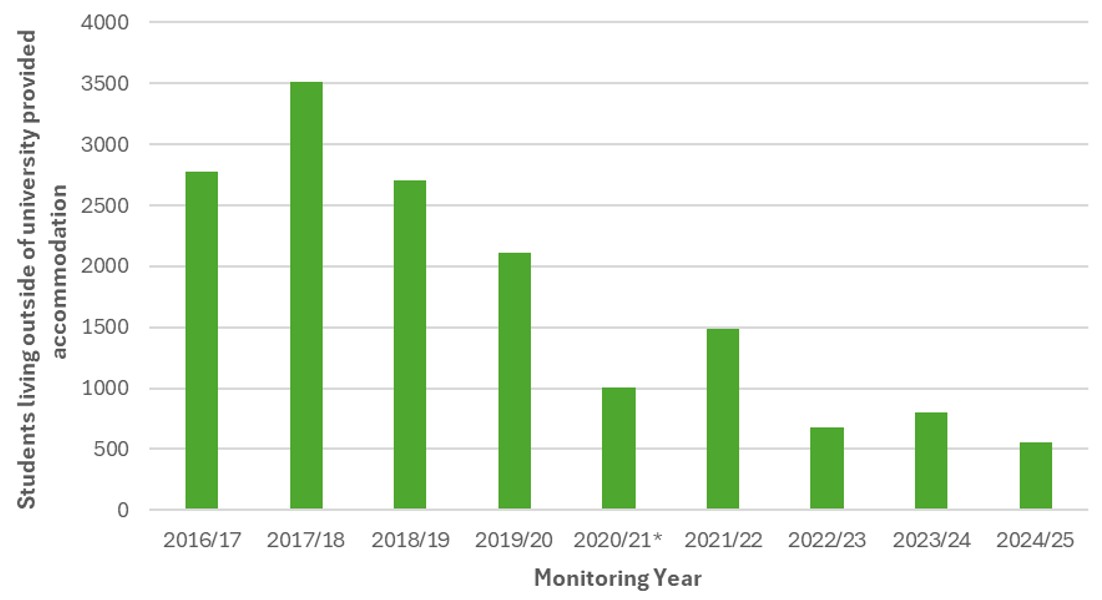
(*Note: Student numbers contributing to the threshold for 2020/21 onwards have been redefined according to the Local Plan 2036 definition and only include full-time, taught-course students. Please refer to Appendix 3.5 in the Local Plan to see the full list of student exclusions.)
| Monitoring year | Total number of students | Students needing accommodation in Oxford | Units of university provided student accommodation | Students living outside of university provided accommodation |
|---|---|---|---|---|
| 2016/17 | 23,179 | 17,753 | 14,976 | 2,777 |
| 2017/18 | 23,975 | 18,221 | 15,047 | 3,508 |
| 2018/19 | 24,289 | 18,112 | 15,409 | 2,703 |
| 2019/20 | 24,510 | 18,413 | 16,299 | 2,114 |
| 2020/21 | 25,816 | 14,724 | 13,715 | 1,009 |
| 2021/22 | 26,439 | 14,873 | 13,382 | 1,491 |
| 2022/23 | 26,497 | 14,653 | 13,975 | 678 |
| 2023/24 | 26,945 | 15,404 | 14,603 | 801 |
| 2024/25 | 26,595 | 14,959 | 14,407 | 552 |
Oxford Brookes University
3.17. Oxford Brookes University states that there was a total of 21,856 students attending the university as of 1 December 2024.
3.18. A number of agreed exclusions apply to the data:
- Part-time students (2,199 students)
- Students on a research-based PG degree (149)
- Students on a Further Education course or foundation degree (102)
- Vocational Course students who will at times during their course be on work-placements (1295)
- Students with a term-time address outside of the city (OX1, 2, 3, 4) (1616)
- Students living within the city (OX1, 2, 3, 4) prior to entry onto a course (391)
- Students studying at franchise institutions (7336 students) (The figure includes Global Banking School (GBS) Students. This is a partnership with Oxford Brookes University to provide a BSc in Health, Wellbeing and Social Care for students. The campuses are only based in London, Birmingham, Manchester and Leeds. Therefore, these students are considered to be studying at a franchise/ partner institution and are excluded from the calculation of students at Oxford Brookes University requiring accommodation.)
- Students studying outside Oxford (i.e., Swindon campus) (230 students)
- Placement students away from the university (312 students)
3.19. Taking into account these exclusions, there were 8,226 full-time Oxford Brookes University students with accommodation requirements. As of 1 December 2024, there were 5,094 accommodation places provided by Oxford Brookes University. This leaves a total of 3,132 students without a place in university provided accommodation living in Oxford (Figure 2). It is noted from the University provided data, the occupancy rates of the University provided accommodation was at 90% overall (2024/25), which is lower than previous monitoring years (95% in 2023/24).
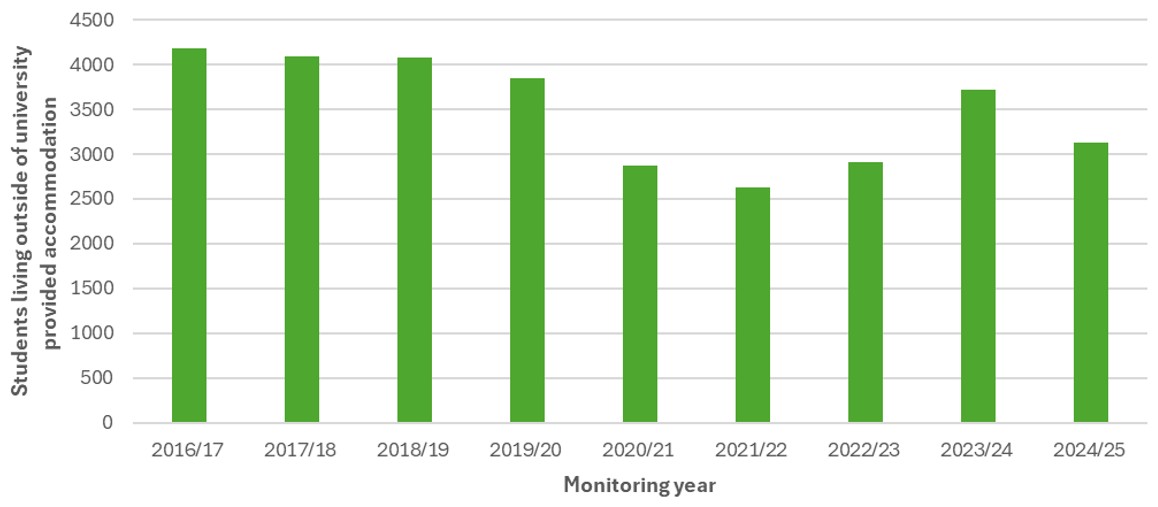
(*Note: Student numbers contributing to the threshold for 2020/21 onwards have been redefined according to the Local Plan 2036 definition and only include full-time, taught-course students. Please refer to Appendix 3.5 in the Local Plan to see the full list of student exclusions.)
3.20. When compared to the previous monitoring year, there was a decrease in the number of Oxford Brookes students living outside of university provided accommodation in the city in 2024/25. A more detailed breakdown of Oxford Brookes University’s student numbers is provided in Table 7. Table 7 also indicates that there has been an increase in the number of University provided student accommodation units since the last monitoring year. This is a result of ongoing work at the Clive Booth Student Village site.
| Monitoring year | Total number of students | Students needing accommodation in Oxford | Units of University provided student accommodation | Students living outside of university provided accommodation |
|---|---|---|---|---|
| 2016/17 | 17,069 | 9,504 | 5,324 | 4,180 |
| 2017/18 | 16,988 | 9,494 | 5,405 | 4,089 |
| 2018/19 | 16,579 | 9,360 | 5,281 | 4,079 |
| 2019/20 | 16,673 | 9,759 | 5,914 | 3,845 |
| 2020/21 | 16,878 | 8,164 | 5,291 | 2,873 |
| 2021/22 | 16,199 | 7,794 | 5,161 | 2,633 |
| 2022/23 | 16,050 | 7,531 | 4,623 | 2,908 |
| 2023/24 | 19,586 | 8,577 | 4,857 | 3,720 |
| 2024/25 | 21,856 | 8,226 | 5,094 | 3,132 |
Approved additional academic and administrative floorspace
3.21. Permissions which involve the creation of additional academic and administrative floorspace, which are compliant with the requirements of policies E2 and H9 unless stated otherwise, are shown in Table 8:
| Application reference | Site location | Development summary | Net increase of academic/admin floorspace onsite (sqm) | Compliance with E2 or H9 requirements |
|---|---|---|---|---|
| 24/00334/FUL | 3 - 7 New Inn Hall Street, Oxford | Change of use of the second floor of Thomas Hull House from office (Use Class E(g)(i)) to Middle Common Room (Use Class F1) in connection with St Peter's College | 276 | Yes |
| 22/02849/FUL | Land At Winchester Banbury And, Bevington Road, Oxford | The development of land at Winchester, Banbury and Bevington Road for the provision of student accommodation through the construction of accommodation buildings, a new villa on Bevington Road and the conversion of 43-45 Banbury Road together with a student pavilion building, an academic accommodation building | 11538 | Yes |
| 24/01355/FUL | 37 St Giles', Oxford, OX1 3LD | Change of use from House in Multiple Occupation (Use Class C4) to academic, teaching and office accommodation (Sui Generis) | 139.54 | Yes |
| 24/01821/FUL | Department Of Physiology , Parks Road, Oxford, OX1 3PT | Demolition of part of the third floor and construction of new rooftop extensions. The refurbishment and reconfiguration of the third floor to allow for the creation a new academic hub with flexible seminar and innovation space, flexible open laboratories, support space and research offices | 1117 | Yes |
| 24/00650/FUL | St Catherine's College , Manor Road, Oxford, OX1 3UJ | Erection of temporary marquees for use as a lecture theatre on the lawns | 630 | Yes |
| 24/00481/FUL | Oxford Brookes University , Headington Road, Oxford, OX3 0BP | Erection of a temporary educational structure (Use Class F1) | 65 | Yes |
| 24/01392/FUL | Oise House , 38 Binsey Lane, Oxford, OX2 0EY | Change of use from offices (Use Class E(g)(i)) to education (Use Class F1) | 414 | Yes |
| 24/00854/FUL | Gibson Building Radcliffe Observatory Quarter Woodstock Road Oxford Oxfordshire OX2 6GG |
Partial demolition of existing building. Erection of infill extensions and formation of enclosed courtyard. Alterations to roof, fenestration, landscaping, provision of bin and cycle storage and other associated works to create the Oxford Institute of Digital Health (Use Class F1) | 363 | Yes |
Total: 14,542.54sqm
Ensuring Oxford is a vibrant and enjoyable city to live in and visit
3.22. Oxford provides a wide range of services and facilities to both the city’s residents and those living in the wider catchment area, therefore it is important that the vibrancy and vitality of Oxford’s city, district and local centres are maintained and enhanced through the plan period. The vision for the Oxford Local Plan 2036 is to continue to build on these strengths and to focus growth in these centres.
3.23. Policy V1 aims to protect the vitality of the city, district and local centres within Oxford. Policies V2 – V4, meanwhile, provide the framework as to what mix of uses, such as retail or food and drink, (and identified through percentages allocated to each use class) would be acceptable within the shopping frontages of these centres, including the Oxford Covered Market. These policies place a particular emphasis on the minimum proportion of retail units at ground floor level that should be present within each shopping frontage in order to ensure that the function, vitality and viability of each centre is maintained.
V1 - Ensuring the vitality of centres
3.24. The Local Plan states that permission will be granted for development of town centre uses within the defined city, district, and local centre boundaries if use is appropriate to both the scale, function, and character of the area. The policy also states that the city centre will continue to be a primary location for retailing as well as other town centre uses. Continuing to provide a wide diversity of uses to shoppers will create an attractive destination for people visiting the city. One means of understanding how the centres are performing in terms of vitality is to assess how many people are using these areas throughout the year.
Adapting to the changes to Use Classes Order
3.25. Changes to the Use Classes Order came into effect on 1 September 2020. (Current Use Classes - updated 1 September 2020 - see the Planning Portal website - Use classes). Four years have now passed, allowing adaptation to the change to occur. The changes make monitoring of policies based on the former Use Classes referred to in the Local Plan 2036 difficult.
V2 - Shopping frontages in the city centre
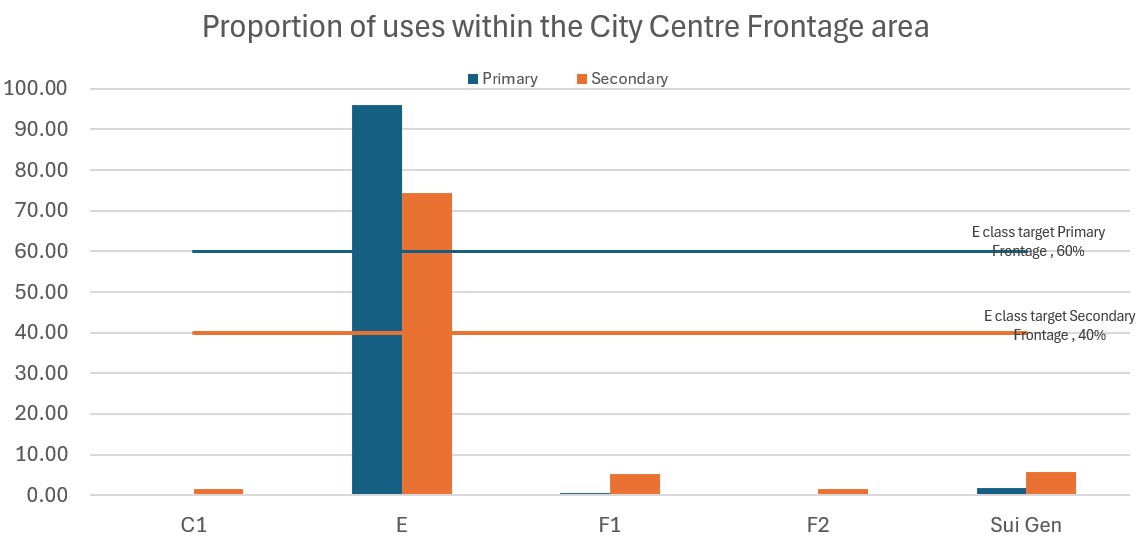
3.26. Policy V2 sets out how shopping frontages are managed within the city centre. The policy sets out that planning permission will only be granted for proposed development that would not result in the proportion of units at ground floor level in Class A1 or other Class A uses falling below 60% of the total number of units within the defined Primary Shopping Frontage or 40% of units in the rest of the shopping frontage. When applying the policy, in response to the change to the Use Class Order, the threshold required by the Policy to be Use Class A is instead applied to Use Class E. Figure 4 shows that the proportion of E Class Use in the city centre primary frontage is 95.91%, which is an increase from last year (94.74%). Within secondary areas of the city centre E Class uses are down from last year at 75.47% to 74.27%.
V3 - Covered Market
3.27. During the 2024/25 monitoring year there were 0 (change of use) applications permitted in the Covered Market.
V4 - District and local shopping centre frontages
3.28. Outside of the city centre area, Oxford’s district and local shopping centre frontages also play an important role in providing a wide range of services across the city.
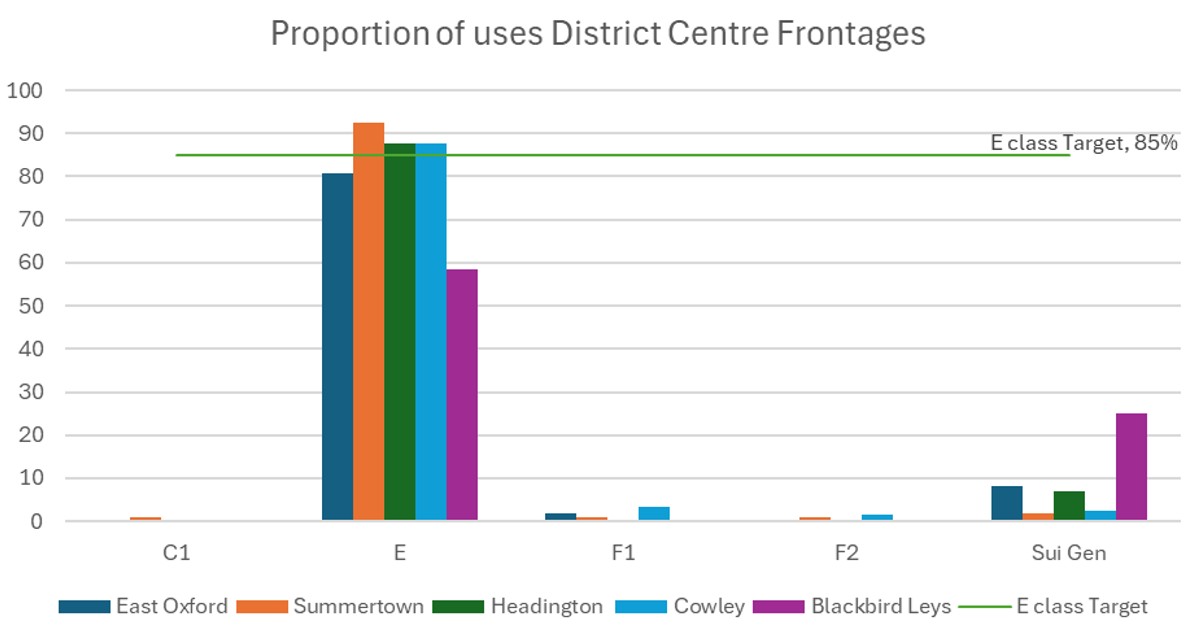
3.29. In order to help maintain a balance of uses, Policy V4 sets out for each district centre its own individual targets in terms of A1 provision and Class A provision which is now categorised as Class E. Figure 5 shows the percentage of use class share across Oxford’s district centres. Similar to last year’s AMR, Headington, Summertown and Cowley continue to sit above the 85%. East Oxford, predominantly of the Cowley Road and Blackbird Leys are lower in comparison to other district centres, at 81% and 58% respectively.
Sustainable tourism
Tourism is an important element of Oxford’s economy. The city is world famous and attracts a large number of visitors and many overnight stays; it is a crucial destination of the national tourism industry. Over 9.4m people visited the city centre between September and November 2024 compared to just 8m in the same period of 2023 as shown in the table below.
| Monitoring Period (Sep - Nov) | Number of visitors in the period |
|---|---|
| 2022/23 | 7,530,926 |
| 2023/24 | 8,027,642 |
| 2024/25 | 9,412,016 |
3.30. Policy V5, ‘Sustainable Tourism’, seeks to encourage development of new tourist accommodation in the most sustainable locations which are not dependent upon the private car and that do not involve the loss of residential dwellings or affect the amenity of neighbours. Policy V5 encourages new tourist attractions in accessible locations well related to existing facilities and where such uses can contribute to regeneration.
3.31. Over the monitoring period, 4 applications were permitted involving short term accommodation, use Class C1 (Table 9). Two of these permissions will result in increases in C1 accommodations.
| Application reference | Site location | Development summary | +/- |
|---|---|---|---|
| 21/01695/FUL | Thornhill Park (Nielsen House) | Proposed development of 402 apartments (Class C3), a 133 bed hotel (Class C1), employment provision in the form of an Innovation Centre (2,200 sqm), with additional mixed use accommodation to include office space, gym, café and restaurant (all within Class E) | +133 |
| 24/00768/FUL | 222 London Road Headington | Change of use from House in Multiple Occupation (Use Class C4) to Hotel (Use Class C1) | +5 |
| 24/00319/FUL | 244 - 246 Iffley Road Oxford | Change of use from Boarding House (Use Class C1) and conversion to create 2 x 6 bed dwelling houses (Use Class C3) | -437.65m2 |
| 24/02812/FUL | 250 Iffley Road Oxford Oxfordshire OX4 1SE | Change of use from hotel/bnb (Use Class C1) to dwellinghouse (Use Class C3) | -8 (-456m2) |


