

The government has announced that Oxfordshire and West Berkshire’s seven existing councils will be replaced by three unitary councils on 1 April 2028.
The new councils will be:
- Greater Oxford Council – covering Oxford and its immediate surroundings
- Northern Oxfordshire Council – covering most of the existing Cherwell and West Oxfordshire districts
- Ridgeway Council – covering most of the existing South Oxfordshire and Vale of White Horse districts, combined with West Berkshire
Each council will be responsible for all local council services in its area, including housing, planning, waste collection, roads and social care.
The new structure is intended to simplify local government and save money, while keeping decision-making local and supporting the delivery of new homes.
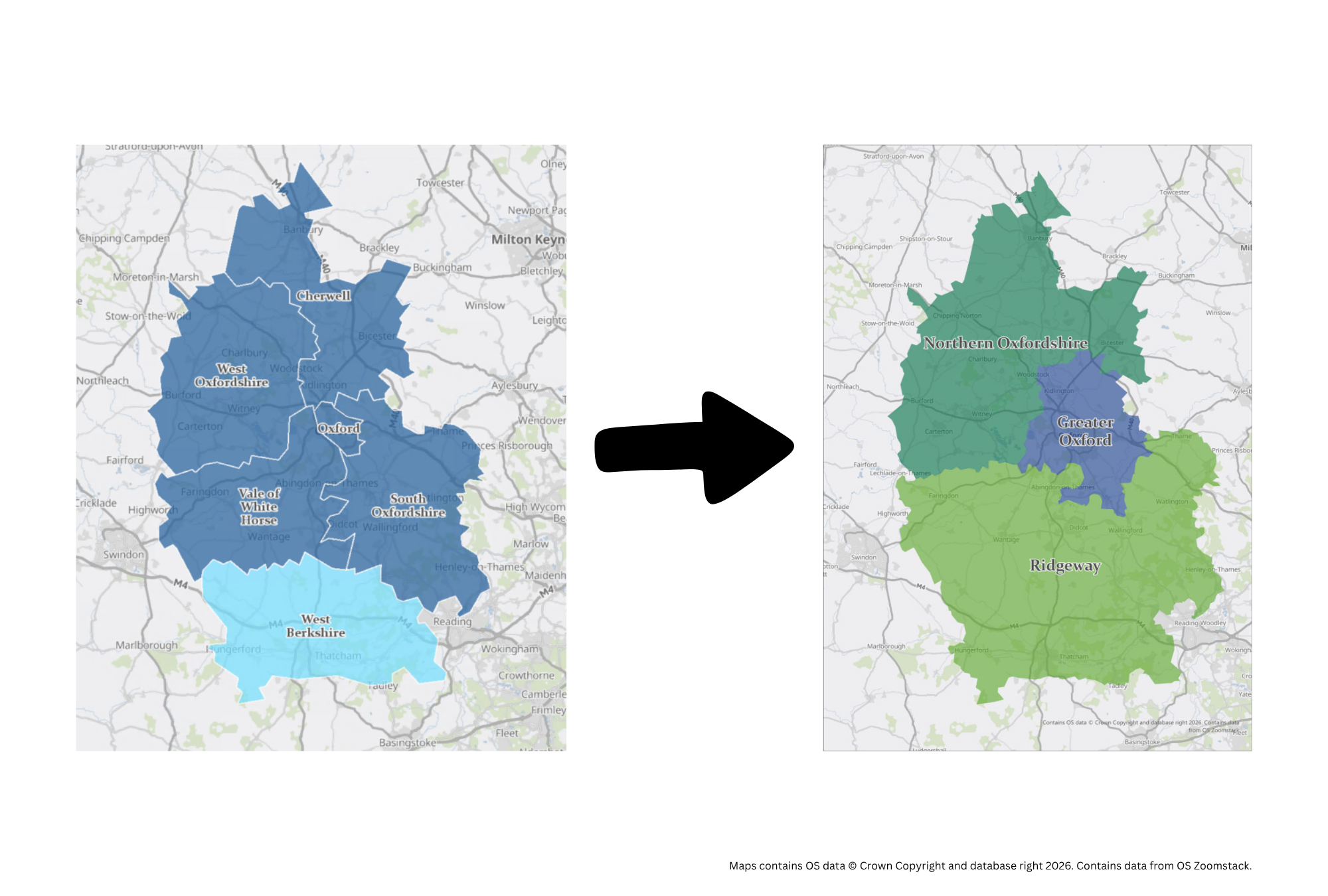
For a detailed and interactive map of the new council boundaries, visit 3councils.org.
Three proposals
The government asked councils across England to put forward proposals to simplify local government in their areas.
Oxfordshire’s councils submitted three proposals in November 2025, setting out options for one, two or three unitary councils.
Oxford City Council led the development of the three-council proposal.
In February and March, the government ran a public consultation on the proposals, inviting views from residents, businesses and local stakeholders.
We expect the consultation results to be published in the coming days.
Benefits of three councils
All three options would have simplified local government for residents and saved money by reducing the number of councils across the region.
The three-council proposal was the only one that recognised that Oxford city and rural Oxfordshire are different, with different demographics, economies and challenges.
The proposal will create separate councils for urban Oxford and rural Oxfordshire, meaning services can be tailored to meet the specific needs of local residents and businesses.
The three-council proposal is also the only one that aims to tackle Oxfordshire’s housing crisis.
It aims to do this by using 2.6% of Oxford’s 35,000-hectare Green Belt to build 40,000 new homes – including 16,000 social and affordable homes – close to the city by 2040.
By concentrating homes and new jobs close to Oxford, rather than across the county, it would also protect rural Oxfordshire from overdevelopment and sprawling towns and villages.
By year five of the transition, the three-council proposal is expected to save £48.6m every year across Oxfordshire and West Berkshire.
But economists found that enabling Oxfordshire and West Berkshire’s economy through the three-councils proposal would also generate £170bn for the UK’s economy by 2050 – £43bn more than the one-council proposal.
Full details of the three-council proposal can be found on www.3councils.org.
Watch 'Why and how Oxfordshire's councils are changing in 2028' on YouTube (2 minute, 18 seconds)
Other proposals
In making its decision, the government rejected the proposals for one council and two councils across Oxfordshire and West Berkshire.
The one-council proposal would have created the second largest council in England by population, after Birmingham.
The two-council proposal would have merged the existing districts of Oxford, Cherwell and West Oxfordshire, which would have put Blackbird Leys and Burford in the same council.
Next steps
The new unitary councils will be created on 1 April 2028. On the same day, Oxfordshire and West Berkshire’s seven existing councils will be abolished.
Elections for the new unitaries will take place in May 2027, after which shadow authorities will be created to plan the new councils, but they will not deliver services. They will focus on preparing for the future councils.
There will be no immediate changes to council services as a result of today’s announcement.
Oxfordshire and West Berkshire’s existing councils will continue to work together to prepare for the transition and keep residents and businesses informed about the changes.
Comment
“Today is a historic day. This decision will shape the future of Oxford, Oxfordshire and West Berkshire for generations.
“Our proposal will simplify local government, save money and keep decision-making local, so each area can shape services around the specific needs of its residents and businesses.
“It means Witney and Banbury won’t be overshadowed by a focus on Oxford, while South Oxfordshire and the Vale of White Horse can build a new future with West Berkshire, reflecting the history and connections they share.
“But this decision is also about tackling the housing crisis and creating well-paid, secure jobs.
“By focusing development around Oxford, rather than continuing the incremental expansion of towns and villages across rural Oxfordshire, we can deliver the homes people need while protecting more green space overall.
“Oxford has needed more room to grow for a generation. The government has listened, and from 1 April 2028 we will have a genuine opportunity to make Oxford and Oxfordshire more affordable for our children and grandchildren.”
Councillor Susan Brown, Leader of Oxford City Council


