

Contents
- Purpose
- Scope
- Related Documents
- Legal Framework
- Glossary
- Equality and Diversity
- Policy Statement
- Key Roles and Responsibilities
- Resident Engagement
- Management Arrangements, Reporting, Competency and Assurance
- Escalation
- Monitoring and Review
- Record keeping
- Record Keeping - Staff and Contractors
- Resident Involvement
1. Purpose
1.1. The Property Compliance Policy details how we meet the legal obligations we have as a landlord and as an employer. This is critical in enabling us to deliver our strategic goals and to provide quality and safe homes for our residents and leaseholders. The specific compliance themes and the requirements associated with them range from ‘threat to life’ responsibilities, such as gas safety and fire safety, through to administrative technicalities set out in various regulations. This policy document confirms our objectives and intent. It also goes on to describe.
- How we organise ourselves to meet this objective,
- Our headline commitments, and
- How we report performance.
1.2. As a registered social landlord, freeholder and employer, we operate in a unique regulatory environment whereby the effect of any non-conformance with regulatory requirements can be amplified through the impact on our relationship with the Regulator for Social Housing (RSH), and notably their assessment of our governance arrangements and our performance in meeting the Decent Homes Standard. We operate in the spirit of co-regulation with the RSH. We also have important working relationships with some of our local regulators, such as Oxfordshire Fire & Rescue and other local fire services, as well as national regulators such as the Health & Safety Executive, the Building Safety Regulator, and the Environment Agency.
1.3. We manage this and other risks through our risk management framework and our three lines of defence. These include:
- effective operational management,
- risk and compliance management and
- our internal audit and governance functions, providing independent and objective assurance.
2. Scope
The primary focus of this policy is the residential portfolio, managed by the Housing function of the Directorate, while remaining aligned with the overarching Corporate Health & Safety policies.
3. Related Documents
3.1. The Following Documents must be read in conjunction with this policy.
- Strategic Compliance Plan
- H&S Strategy
- All Property Compliance Procedures and Briefing Notes
- Fire Safety
- Building Safety
- Gas
- Radon
- Lifts
- Asbestos
- Water
- Electrical
4. Legal Framework
Oxford City Council (OCC) will adhere to all relevant legislation under The Health and Safety at Work Act and related legislation, such as the Housing Act 2004, the Management of Health and Safety at Work Regulations 1999, Building Regulations, and the approved documents, etc. The information below lists those specific to each of the 'Big 6' as targeted in this Compliance Policy and OCC obligations.
1. Gas
The Gas Safety (Installation and Use) Regulations 1998 (as amended ) and ACOPs and any subsequent amendments.
Obligation:
To adhere to the landlord's main duties as listed in “A guide to landlords’ duties: Gas Safety (Installation and Use) Regulations 1998 as amended”.
- Ensure gas Appliances, fittings, and flues are maintained in a safe condition. Ensure that an annual safety check is carried out on Gas Appliances and Flues and that ongoing maintenance is carried out. Gas appliances should be serviced in accordance with the manufacturer’s instructions and annually by a Gas Safe registered engineer.
- Ensure an annual safety check is carried out on each gas appliance/flue and pipework Before any new lease starts, you must make sure that these checks have been carried out within one year before the start of the lease date, unless the appliances in the property have been installed for less than 12 months, in which case they should be checked within 12 months of their installation date.
- Keep the record of the gas safety check until two further checks have been carried out (this may be longer than two years).
- Issue a copy of the latest safety check record to existing tenants within 28 days of the check being completed, or to any new tenant before they move in (in certain cases, there is an option to display the record electronically).
2. Fire and Building Safety
The Regulatory Reform (Fire Safety) Order 2005, as amended by the Fire Safety Act 2021, The Fire Safety (England) Regulations 2022, Building Safety Act 2022 (BSA) & subsequent secondary legislation.
Obligation:
Oxford City Council (OCC) is committed to full compliance with the Regulatory Reform (Fire Safety) Order 2005 (FSO), including all landlord duties outlined in Articles 8–24. Particular attention is given to:
- Article 8 – Duty to take general fire precautions: Ensuring that appropriate fire safety measures are in place to protect occupants and property.
- Article 9 – Risk assessment: Conducting and maintaining up-to-date fire risk assessments, identifying hazards, and implementing necessary controls.
Update – Fire Safety Act 2021:
Following the Fire Safety Act 2021, fire risk assessments (FRAs) now explicitly include the external walls, cladding, balconies, and attachments of buildings. OCC ensures that all FRAs reflect this expanded scope, mitigating potential risks and maintaining regulatory compliance.
The Fire Safety (England) Regs 2022 - These regulations made it a requirement in law for responsible persons of high-rise blocks of flats to provide information to Fire and Rescue Services to assist them to plan and, if needed, provide an effective operational response.
Also, the regulations require responsible persons in multi-occupied residential buildings, which are high-rise buildings, as well as those above 11 metres in height, to provide additional safety measures.
In all multi-occupied residential buildings, the regulations require responsible persons to provide residents with fire safety instructions and information on the importance of fire doors. The regulations apply to existing buildings, and requirements for new buildings may be different.
The Building Safety Act 2022 – This Act makes ground-breaking reforms to give residents and homeowners more rights, powers, and protections – so homes across the country are safer.
It delivers far-reaching protections for qualifying leaseholders from the costs associated with remediating historical building safety defects, and an ambitious toolkit of measures that will allow those responsible for building safety defects to be held to account.
It overhauls existing regulations, creating lasting change and making clear how residential buildings should be constructed, maintained, and made safe.
The Act creates three new bodies to provide effective oversight of the new regime: the Building Safety Regulator (BSR), the National Regulator of Construction Products, and the New Homes Ombudsman.
Together, these changes mean owners will manage their buildings better, and the home-building industry has the clear, proportionate framework it needs to deliver more and better, high-quality homes.
3. Electricity
- The Health and Safety at Work etc. Act 1974, (HSWA), Electricity at Work Regulations 1989, The Management of Health and safety at Work Regulations 1999, Provision and Use of Work Equipment Regulationss 1998 (PUWER)
- Landlord and Tenant Act 1985
- The Housing Act 2004
Obligation:
HSWA – Applies to everyone (employers and employees) in general terms, concerned with work activities and provisions to protect members of the public.
Electricity at Work Regulations 1989 – ensures that precautions are taken against the risk of death or personal injury from electrical work activities. Aimed at those involved in the design, construction, operation, or maintenance of electrical systems and equipment.
The Management of Health and Safety at Work Regulations 1999 – Aimed at Employers, managers, and other duty holders for H&S, requires them to assess the risks posed to workers and any others who may be affected by their work or business.
PUWER – Requirements for equipment provided for work use:
- Suitable for the intended use.
- Safe for use, maintained, and inspected to ensure it is correctly installed and does not deteriorate.
- Used only by people who have had adequate information, instruction, and training.
- Accommodated by suitable H&S measures.
- Used in accordance with specific requirements for mobile work equipment.
Landlord and Tenant Act 1985 – Section 11 sets out who is responsible for repairing a property whilst it is being rented.
The Housing Act 2004 – Main provisions:
- The housing, health, and safety system (HHSRS).
- Enforcement of housing standards.
- Licensing of HMO’s.
- Empty homes.
- Home information packs.
Plus, many others:
Homes (Fitness for Habitation) Act 2018, The Consumer Protection Act 1987, Regulatory Reform (Fire Safety) Order 2005, Defective Premises Act 1972, The Electrical Equipment (Safety) Regulations 1989, Building Regs and the Approved Docs A-R, noting ADP – Electrical safety in Dwellings, IET wiring Regs 18th edition.
4. Asbestos
- Control of Asbestos Regulations (CAR) 2012
- Reporting of Injuries, Diseases, and Dangerous Occurrences, RIDDOR.
- HSG 227: A comprehensive guide to managing asbestos in premises. Approved Code of Practice (ACOP)
- HSG 210 – Asbestos Essentials, ACOP
- Other ACOPS:
- HSG247 – Licensed Contractors
- HSG 248 – The Analyst's Guide
- HSG 264 – The survey guide
- L143 & L127 – The management of and work with ACM in non-domestic premises.
Obligation:
CAR 2012 – Sets minimum standards for the protection of employees from the risks of exposure to Asbestos Containing Materials, ACMs.
Applies to work that disturbs or is likely to disturb ACM, ACM sampling, and laboratory analysis.
Noting key Regulations below:
Reg 3 – Application.
Reg 4 – Duty to manage in non-domestic premises.
Reg 5 – Identification of the presence of ACM.
Reg 8 – Licensing of work with ACM.
Reg 9 – Notification of work with ACM.
Reg 10 – Information, instruction, and training.
Reg 11 – Prevention or reduction of exposure.
Reg 16 – Duty to prevent or reduce the spread of ACMs.
RIDDOR – Places duties on employers and other duty holders to report certain serious workplace accidents, occupational diseases, and specified dangerous occurrences. Exposure to ACMs is a dangerous occurrence.
HSG 227 – Extensive guidance for those with a duty to manage the risks from asbestos-containing materials (ACMs) in premises, e.g., building owners, tenants, and anyone with legal responsibilities for workplaces.
HSG 210 - A task manual for building, maintenance, and allied trades of non-licensed asbestos work.
5. Water
- The Health and Safety at Work etc. Act 1974 (HSWA),
- Control of Substances Hazardous to Health Regulations 2002 (COSHH)
- ACOPs - L8, HSG 274 PARTS 1-3, plus many others
Obligation:
HSWA – Applies to everyone (employers and employees) in general terms, concerned with work activities and provisions to protect members of the public.
COSHH – Risk assessments must be carried out to assess any risks and to minimise harm. If employers fail to control hazardous substances, this can lead to staff becoming ill from mild eye irritation to chronic lung disease, and could lead to civil prosecution, loss of productivity, enforcement action, and reputational damage. Legionella is a biological agent and is a hazardous substance under COSHH.
L8 - ACOP – the control of legionella bacteria in water systems, applies where HSWA Act applies. To comply, employers must:
Risk assesses, provide a written scheme as required, monitor systems, and appoint a responsible person.
HSG 274 – Part 1-3 – details requirements for risks from cooling towers, cold water systems, and all other risk systems.
6. Lifts
- The Health and Safety at Work etc. Act 1974 (HSWA),
- Lifting Operations & Lifting Equipment Regulations 1998 (LOLER)
- Provision and Use of Work Equipment Regulations 1998 (PUWER)
Obligation:
HSWA – Applies to everyone (employers and employees) in general terms, concerned with work activities and provisions to protect members of the public. Section 3 applies to the use and maintenance of passenger lifts by the public.
LOLER – Places duties upon persons and organisations who own, operate, provide, or have control over lifting equipment. To ensure it is fit for purpose, appropriate for the task, suitably marked, and in many cases, subject to statutory periodic thorough examination.
PUWER – Requirements for equipment provided for work use:
Suitable for the intended use.
Safe for use, maintained, and inspected to ensure it is correctly installed and does not deteriorate.
Used only by people who have had adequate information, instruction, and training.
Accommodated by suitable H&S measures.
Used in accordance with specific requirements for mobile work equipment.
7. Radon
- Housing Act 2004
- Ionising Radiation Regulations 2017
- Housing Health and Safety Rating system
- Health & Safety at Work etc. Act 1974
- Management of Health & Safety at Work Regulations 1999
- The Building Regulations 2010 Approved Document C (2013 edition)
- Construction (Design and Management) Regulations 2015
- Control of Substances Hazardous to Heath Regulations 2002.
Obligation:
Under the Housing Act 2004’s Health and Safety Rating System (HHSRS) the Council has a legal obligation to:
- assess risks associated with radon gas in our properties
- where the elevated levels of radon gas are identified, take appropriate action to mitigate the reduce this to a safe level.
The Building Regulations 2010 Approved Document C (2013 edition) also require that where significant alterations are made to buildings or new buildings are constructed in high radon areas, protective measures are taken to eliminate the build-up of radon gas, though the presence of radon in east Oxford does not meet this threshold.
To ensure the Council is able to fulfil its responsibilities in relation to the management of radon the Council will:
- provide sufficient resource to manage radon gas effectively
- implement suitable and sufficient governance arrangements to manage the risks associated with radon gas
- allocate responsibilities and duties in relation to radon
- employee competent persons to manage radon programmes
- conduct radon testing, where required, within suitable timeframes
- install suitable mitigation to reduce radon levels where testing shows that they exceed the action threshold
- implement effective radon management record keeping
- operate effective contract management arrangements with the contractors responsible for delivering the service, including ensuring contracts are in place, conducting client-led performance meetings and ensuring the contractors employee and public liability insurances are up to date on an annual basis
- engage with customers to inform and promote radon awareness
- use the legal remedies available within the terms of the tenancy or lease agreement should any tenant, leaseholder or shared owner refuse access to conduct essential radon related inspection and remediation works.
- conduct and maintain a risk and control self-assessment for radon management and operations setting out our key risks from radon and appropriate mitigations.
5. Glossary
- BSC - Building Safety Case
- BSC R - Building Safety Case Report
- BSA - Building Safety Act
- RP - Responsible Person
- PAP/AP - Principle Accountable Person / Accountable Person
- FRA - Fire Risk Assessment
- WRA - Water Risk Assessment
- LGSR - Landlord's Gas Safety Record
- EICR - Electrical Installation Condition Report
- LOLER - Lifting Operations & Lifting Equipment Regulations (LOLER)
- PUWER - Provision and Use of Work Equipment Regs 1998 (PUWER)
- HSWA - The Health and Safety at Work Act
- FSO -Regulatory Reform (Fire Safety) Order 2005
6. Equality and Diversity
6.1. OCC is committed to ensuring that no person or group of persons will be treated less favourably than another person or group of persons and will carry out our duty with positive regard for the following core strands of the protected characteristics as defined under the Equality Act 2010 being - Age, Disability, Gender, Race, Gender Identity / Gender Expression, Sexual Orientation, Pregnancy and Maternity, Marriage and Civil Partnership, Religion and/or Belief.
6.2. OCC also recognises that some people experience disadvantage due to their socio-economic circumstances, employment status, class, appearance, responsibility for dependants, unrelated criminal activities, being HIV positive or with AIDS, or any other matter which causes a person to be treated with injustice.
6.3. OCC will also ensure that all services and actions are delivered within the context of current Human Rights legislation. Staff and others with whom we work will adhere to the central principles of the Human Rights Act (1998).
7. Policy Statement
Statement of Intent
OCC is committed to ensuring that HRA properties and HRA property-focused operations are fully compliant with all applicable laws and regulations. This supports us in providing a safe home for our residents, to protect our assets, and to reinforce our reputation as a responsible landlord.
We do this by:
- understanding the legal requirements.
- knowing our properties and our activities.
- maintaining an operational risk management approach.
- maintaining externally certified management systems.
- having competent, well-trained staff.
- maintaining records and data.
- communicating key compliance messages.
- engaging openly and proactively with our regulators and other stakeholders.
- clearly reporting compliance performance.
- undertaking internal checks and audits, and
- seeking external challenge and review.
Health and Safety is covered by the OCC’s Health and Safety Policy and operates in parallel to this policy. As such, the focus of property compliance is across the six main themes of:
- Gas safety
- Fire & Building safety
- Electrical safety
- Asbestos management
- Legionella management
- Lift management
- Radon management
Whilst these are our focus, we also recognise and commit to comply with the full range of legal requirements as they apply to us, including, but not limited to, the requirements of the Housing Act, the Government’s Regulatory Framework & the relevant Standards, environmental legislation, energy efficiency legislation, planning legislation, and transport/vehicle legislation.
8. Key Roles and Responsibilities
Many of the regulatory requirements apply to us as a corporate body. To support compliance across the main themes, we have highlighted several key roles.
The employer or, where applicable, the owner/occupier of the building will ensure relevant guidance, information, training, and equipment are in place for anyone with specific responsibilities and all other staff.
The Employer (OCC) for the purposes of this policy is the Responsible Person, Accountable person, and Employer as the Duty Holders (for other relevant legislation). Although this is designated/delegated through to operational leads, ultimately the Chief Executive is “responsible” as the lead for OCC for ensuring compliance.
Meaning of “responsible person”
3. In this Order, “responsible person” means—
(a) in relation to a workplace, the employer, if the workplace is to any extent under their control.
(b) in relation to any premises not falling within paragraph (a) —
(i) the person who has control of the premises (as occupier or otherwise) in connection with the carrying on by him of a trade, business, or other undertaking (for profit or not); or
(ii) the owner, where the person in control of the premises does not have control in connection with the carrying on by that person of a trade, business, or other undertaking.
Meaning of “accountable person”
(1) In this Part, an “accountable person” for a higher-risk building is—
(a) a person who holds a legal estate in possession in any part of the common parts (subject to subsection (2)), or
(b) a person who does not hold a legal estate in any part of the building but who is under a relevant repairing obligation in relation to any part of the common parts.
The employer will appoint the:
Chief Executive as the lead to act as the Responsible Person/Accountable Person, Duty Holder, etc, to ensure the Council’s compliance with all relevant legislation; and will be responsible for ensuring an agreed programme of investment is properly accounted for in the Council’s annual financial planning; and will appoint the following as ‘relevant persons’ to assist with property compliance.
The Deputy Chief Executives to act as Designated leads and act for the employer in fulfilling its legal duties.
The HRA Assets Lead is responsible for the development of policies and strategies in relation to property compliance and providing leadership to the Operational leads. Ensuring systems are implemented, maintained, and regularly monitored.
The Directors, Asset Management & Improvement.
Ensures that they:
Appoint the Heads of Services as required to be the operational leads and ensure they are competent to do so.
Ensures all managers and staff have access to and carry out a relevant level of safety training as provided by the Learning and Development, Health, Safety, and Wellbeing Teams, or other competent persons.
Consults with Employees & Unions about nominating people/contractors to carry out roles (e.g., fire marshals/wardens, re-inspection of ACM, etc.) and about proposals for improving safety precautions.
The Head of Building Safety and Compliance is the operational lead for the Employer in its role as RP and PAP/AP, supporting policy development, appointing compliance strategic leads, and leading on procedure, standards, and guidance in relation to property compliance that is in place and monitored. It is also responsible for Audit and Reporting on agreed performance measures on property compliance, ensuring timely intervention as any emerging risks are identified.
The HRS Assets Lead are the operational leads for staff and works contractors, and ensure the required works are completed using competent resources to the relevant quality/requirements as defined in legislation and in a timely response to all relevant due dates as defined in Legislation, Policy, Procedure, and any contracts awarded.
Provide Employees with clear and relevant information on the risks to them identified by the various assessments and certifications, about the measures taken to prevent safety risks and any safety breaches.
9. Resident Engagement
How OCC communicates with and educates residents and keeps them informed - Key Documents, Reporting & Assurance through the Compliance Resident Group.
An OCC Resident Engagement strategy has been produced and is regularly reviewed. All Policies will be posted on the website and available to all to read.
OCC has created and delivered to all residents a block-specific Resident Engagement Strategy as part of the requirements of the Building Safety Act 2022. These will be reviewed annually in line with the legislation.
10. Management Arrangements, Reporting, Competency, and Assurance
Management arrangements for key documents
The Management arrangements for all 6 Major Compliance areas will be structured as shown:
Corporate:
- Asset Management Strategy
Senior Leadership Team:
- Complaince Policy
Directorate:
- Building Safety SOP
- Fire Safety SOP
- Asbestos Safety SOP
- Lift Safety SOP
- Gas Safety SOP
- Electrical Safety SOP
- Water Safety SOP
Operations:
- Building Safety Briefings etc.
- Fire Safety Briefings etc.
- Asbestos Safety Briefings etc.
- Fire Safety Briefing notes
- Gas Safety Briefings etc.
- Electrical Safety Briefings etc.
- Water Safety Briefings etc.
Delivery Procedures
The Asset Management Service will maintain the quality of management systems to support internal delivery and document control. External delivery providers will be expected to maintain similar standards.
Competency
We will ensure that our teams have the appropriate levels of experience and competency, combining both technical specialisation and management capability. We invest in training our teams and augment capability through external technical advisors where required. Specific competencies will be defined in the Local Directorate/Service Area Procedure Documents.
OCC Agreed Review of key Compliance Certification and Assessments
As described in the various pieces of legislation listed above, certain checks require regular review, some are set in the legislation, others are a policy decision, and others are based on previous assessments. The table below describes OCC’s responsibilities.
| Area | Details | Frequency |
|---|---|---|
| FRA’s | High Risk (includes HRBs, Sheltered, etc, and other considered High risk due to issues of a nature considered high) | 1 Year |
| FRA’s | Medium Risk (Includes 5/6 storey blocks, others considered medium risk) | 2 Years |
| FRA’s | Low Risk (Includes all low-rise blocks 4 storey and below, and everything else not deemed High or Medium) | 3 Years |
| FRA’s | Renewed when any significant changes or incidents are recorded | As required |
| WRA’s | It is a live document in a live system, deemed to be reviewed frequently; however, it should be reviewed regularly as per L8 (The control of legionella bacteria in water systems. Approved Code of Practice and guidance on regulations (L8)” – published by the UK Health and Safety Executive (HSE). | 1 years |
| WRA’s | Low/Medium risk | 3 years |
| WRA’s | Renewed when any significant changes or incidents are recorded | As required |
| LGSR’s | Legal requirement to annually complete a Gas Safety Check and Service using the MOT employed by OCC. Relevant to domestic and commercial Appliances. | 1 year |
| EICR’s | 5 Years (Best Practice for now for social housing providers), or sooner if the renewal date is sooner. Relevant for domestic and communal areas of blocks. (In November 2025 for new tenancies and May 2026 for existing tenancies). | 5 years |
| Asbestos | The Management Survey is carried out and renewed sooner if significant changes are noted | 10 years |
| Asbestos | Re-inspection is carried out every year, where ACMs are identified in the Management survey | 1 year |
| Asbestos | Refurbishment & Demolition – carried out as required before any planned works | As required |
| Lifts - LOLER | Passenger Lifts – legal requirement in common areas. Keeping in good order (maintenance) is covered under the Housing Act and HASAW, so good practice in residential properties (although stair lifts in residential premises do not require a LOLER certificate). | 6 months |
| Building Safety | Building Safety Case – legal requirement to submit to the BSR within 28 days once requested – once approved, a Building Assessment Certificate BAC is issued and must be displayed in each block | 5 years |
| Radon | Under the Housing Act’s Health and Safety Rating System (HHSRS) the Council has a legal obligation to:
|
12 months |
Access Policy
OCC will follow a planned access procedure to ensure it meets its legal responsibilities as required with all tenures as per the legal section above.
There are avenues for planned access, including:
- Access for periodic inspections/checks, such as gas and electric.
- Access to remove or inspect for the presence of known hazards, e.g., asbestos, through survey or removal.
- Access to post-inspection works.
- Health and safety breaches.
- Fire & Building Safety requirements, such as Flat entrance and other Fire door Inspections.
Reporting on agreed performance measures
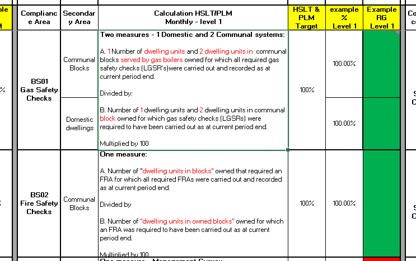
Regular reporting of performance will be communicated to key strategic stakeholders to enable performance monitoring and to support effective governance. Reporting will be completed by the Asset Management Compliance Team.
Assurance and Governance
Assurance of performance is provided through various mechanisms. Specific assurance activities are described in the relevant “Big 6 Procedure”. Assurance is co-ordinated by the Asset Management’s Building Safety & Compliance Team along with technical and engineering support and oversight.
Certification to accredited standards requires 3rd party external verification, which provides us with additional assurance.
11. Escalation
The process for escalation of incidents, risks, and any issues found that cannot be dealt with as per this Policy, other OCC relevant polices, such as H&S, RIDDOR, etc, and the relevant compliance procedures will be via the responsibility chain as listed in section 4.
Whistle blowing
You can raise a concern at any time about an incident that happened in the past, is happening now, or you believe will happen soon.
12. Monitoring and Review
12.1. This Policy will be reviewed every year or sooner if there are significant changes in legislation, management, a major incident, or if it is no longer suitable.
13. Record keeping
13.1. The Council will ensure that records relating to Property Compliance activity are accurate, accessible, and updated regularly. This includes, but is not limited to works involving servicing, risk assessments and remedial repairs and maintenance works.
13.2. Certification and any other relevant documentation must be completed in accordance with the associated statutory regulations and available for inspection where required.
13.3 Internal audits on the Property Compliance services will be undertaken annually, which will include sample checking of certificates. We will also commit to external auditing periodically to ensure quality.
14. Record Keeping - Staff and Contractors
14.1. The Council will either employ directly or procure the services of appropriately trained and qualified personnel in carrying out its statutory responsibilities.
14.2. Where statutory Responsible Persons are required, these are specified in the relevant property compliance policies.
14.3. The Council will always insist that any third-party contractor used to deliver Property Compliance works will be accredited with a relevant governing body for compliance purposes in specialist areas.
15. Resident Involvement
15.1. Oxford City Council is committed to providing a high level of customer care and positive communication which is vital to effective fire safety. This will support residents in their understanding of electrical safety and advise them of how they can manage the risks within their properties and encourage them to report any concerns about fire safety.
15.2. Further monitoring of feedback will take place through resident surveys and this intelligence will be used to inform future reviews of this policy.
15.3. Periodic engagement with residents will take place to ensure that this policy, along with other policies, remain customer facing.
15.4. Advice will be provided on the use of equipment in the welcome pack given to new tenants and information that would be sent from Landlord Services to existing tenants.
15.5. Residents who are wanting to report a non-urgent safety concern can do so by filling in our Report a building safety concern with council housing form.
15.6. All emergency and urgent safety reports should be made to the Customer Contact Centre - speak to customer services.


