

What is the Housing Delivery Test Action Plan
The Government’s latest Housing Delivery Test 2025 Measurement (GOV.UK) published in August 2026, calculates that Oxford delivered 65% of the total homes required for the Housing Delivery Test (HDT) measurement period 2022/23 to 2024/25.
Government Guidance sets out that where delivery is below 95% of the housing requirement for that 3-year period, the authority is required to produce an action plan. It sets out that an action plan should: "identify the reasons for under-delivery, explore ways to reduce the risk of further under-delivery and set out measures the authority intends to take to improve levels of delivery" (Housing Delivery Test guidance on GOV.UK, Paragraph: 039, Reference ID: 68-047-20190722).
This paper explores the factors affecting delivery rates during the measurement period, and measures that could help to increase delivery within Oxford for future years.
Analysis of delivery of homes in Oxford in the Housing Delivery Test measurement period 2022-23 to 2024-25
Table 1 below shows the housing delivery rates for the most recent HDT measurement period, 2022-23 to 2024-25. Note that the figures published in the HDT include adjustments made by MHCLG using census data and ratios for student rooms and other communal dwellings.
| Year | Annual homes requirement for HDT | Homes delivered as recorded in HDT 2025 |
|---|---|---|
| 2022/23 | 567 | 556 |
| 2023/24 | 567 | 284 |
| 2024/25 | 567 | 260 |
Total for measurement period:
- Annual homes requirement for HDT: 1,701
- Homes delivered as recorded in HDT 2025: 1,099
Percentage of total required by HDT:
- Annual homes requirement for HDT: n/a
- Homes delivered as recorded in HDT 2025: 65%
As the data in Table 1 shows, the number of homes delivered in 2022-23 was very close to the target delivery rate of 567, reporting 556 homes were delivered.
In understanding why delivery fell short of the 567 target in the other two years in the measurement period it is helpful to consider some wider context about housing supply and delivery in Oxford. Some of this relates to the general nature of the housing market in Oxford, and some of it relates specifically to the time period being measured, i.e. in the years following the global Covid Pandemic.
General trends of housing delivery in Oxford
The housing supply in Oxford has some unique characteristics, which are discussed in the Strategic Housing Land Availability Assessmen (SHLAA) June 2026 (PDF 1.06kB) and other evidence base studies for Local Plan 2045. Key factors which shape the number of completions, delivery rates, and the types/mix of homes delivered include:
- Oxford is a physically constrained city, built up to the administrative boundary and Green Belt, and with large areas at risk of flooding. This means historically Oxford has been unable to meet its own housing needs (there is substantial “unmet need”). The most recent SHLAA (June 2026) shows that the current capacity for the period 2025-2045 is 9,041, which is significantly less than the calculated level of housing need from the Standard Method calculation (21,560 for the period 2025 - 2045, or 1078 dwellings per annum). This is not a new issue, and Oxford has historically had a capacity-based housing requirement in its local plans.
- The constrained capacity for housing land in Oxford has traditionally meant that there is strong competition for land for housing, student accommodation, employment and other uses, and high land values and property prices (and unaffordability for many).
- The urban nature of Oxford means there is a large proportion of smaller brownfield infill sites, with relatively few larger-scale 'strategic' sites, and even fewer greenfield sites.
- The typically small nature of sites in Oxford means that there are rarely circumstances causing significant delay such as significant pieces of infrastructure or other works necessary to enable them.
- Sites are often opportunistic windfall sites, such as redevelopment or conversion of existing buildings, and so the level of supply varies greatly from year to year.
- There is a relatively high student population and student housing needs.
- Some of the major landowners have a fairly long-term view of their estates and are not necessarily driven by profit; instead, wider issues influence whether they decide to develop a site for residential use, and their delivery timescales.
These factors are not new and have been shaping housing delivery policies in the Local Plan for many years.
Typical delivery trends in Oxford
These characteristics shape not only the total delivery of homes but also annual variations in delivery rates, which can vary quite considerably. As the Oxford CityCouncil: Local Plan Viability Assessment Update (2025) (PDF 9.34MB) notes, the property market in Oxford is inherently cyclical.
For example, in years where there is a larger site building out such as a block of flats or student accommodation, completions rates can be higher, whereas in years where the supply is mainly smaller windfall sites, the completions can be significantly lower. These patterns are not abnormal in Oxford, and when housing supply is considered over a longer time period such as the local plan period, peaks and dips in housing delivery balance out. This is illustrated in Figure 1 below, which shows annual completions rates and forecast supply in coming years:
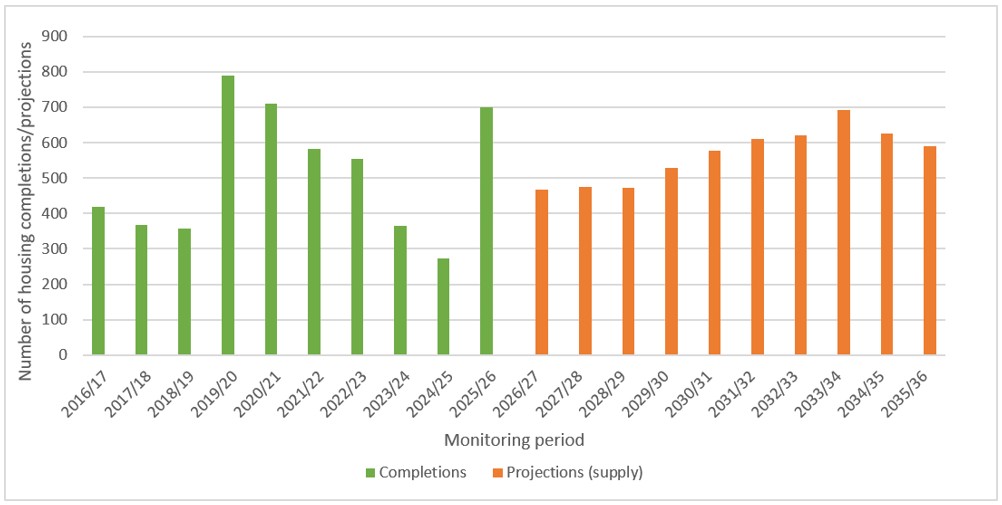
However, as the HDT measurement assesses only 3 specific years, it does not take into account any surplus which may have accumulated in preceding years, and which would in effect compensate for lower delivery in the measurement years. Low delivery in the HDT measurement years is therefore not a failure to deliver homes in Oxford, it is simply the consequence of normal fluctuations in the housing supply, which the constraints of the HDT measurement do not recognise.
This is also illustrated in the fact that until 2025-26 (i.e. until the Oxford Local Plan 2036 became 5 years old, meaning the Standard Method had to be applied), Oxford was able to demonstrate a 5-year housing land supply for decision-making purposes. Similar to the local authority monitoring of housing delivery, the method for calculating 5-year land supply takes into account previous over/under delivery within the plan period. Assessing delivery over a longer time period helps to 'smooth out' the variations in annual delivery. The reason that Oxford could no longer demonstrate a 5-year land supply in the 2025 land supply calculation was again not a reflection on housing delivery, but was simply a mathematical impossibility because the authority was required to replace the local plan housing requirement with the standard method requirement in the calculations, which makes no account of unmet need being delivered in adjoining authorities towards meeting that level of need. The Council is continuing to work with neighbouring authorities to support delivery of unmet need in those areas, but any delivery outside of Oxford cannot be captured in the HDT measurement, or calculation of housing land supply. The Standard Method calculation is a "policy off" figure, that does not account for Oxford’s significant physical constraints on sites and has resulted in a much higher housing need for the city than the adopted LP2036 and its supporting evidence, which has a target of 567 dwellings per annum for the HDT measurement period.
Time-specific circumstances affecting housing supply
Layered on top of these general characteristics of the Oxford market, supply in the period 2022-23 - 2024-25 was also affected by some time-specific factors. This topic is also explored more fully in the Oxford CityCouncil: Local Plan Viability Assessment Update (2025) (PDF 9.34MB):
- Few large strategic sites were building out at that time - several had recently completed or were nearing completion (such as Barton Park, which had been delivering at higher levels previously, and large student accommodation schemes), and others were scheduled to start in forthcoming years (such as several Ox Place sites - see commentary later in this paper about delivery by Ox Place)
- Wider economic turbulence since 2020, including uncertainties from the UK’s departure from the European Union, and the global economic situation (affected by Covid-19 pandemic, the war in Ukraine and other globally significant effects), lead to higher borrowing costs, investor uncertainty, and supply chain and labour market issues
- Uncertainty around the future of higher education, with Brexit impacting on research funding for the universities, student visas, and also shifting patterns of students opting to live at home following Covid, affecting the student accommodation market
- Changed economic circumstances also tipped the balance in this period towards favouring delivery of economic development, particularly research and development, rather than housing, which resulted in fewer conversions from economic sites to housing than had been the case in previous times
Ways to reduce the risk of further under-delivery and measures the authority intends to take to improve levels of delivery
Oxford City Council has long had challenges to housing delivery within such a constrained city, and particularly delivery of affordable housing. So even in years when the HDT was being met, the Council has been monitoring housing delivery (via the Authority Monitoring Report annually) and applying best practice measures to improve its housing delivery. The Council has been proactively seeking to maximise housing delivery to meet as much of its own housing need as possible and, to minimise the amount of unmet housing need. It has also been seeking to maximise delivery of affordable housing, particularly social rent tenures, to address affordability issues of housing in Oxford.
There are a range of programmes, actions and working groups, across Development Management, Planning Policy, and Housing (specifically the Affordable Housing Supply Programme and Enabling Team). Key measures include progressing the emerging Oxford Local Plan 2045 to get an up-to-date local plan in place, increasing direct delivery through council-led and partnership schemes, and ensuring a high performing development management service. In making every effort to identify issues slowing delivery of housing, the Council is also re-establishing an internal Housing Delivery Group meeting. This will be held quarterly and chaired by the Deputy Chief Executive. Collectively these actions are intended to reduce delay, increase certainty, and support a more resilient housing delivery pipeline, helping to mitigate HDT risk while maintaining plan-led growth and community confidence. Some of these measures have been in place for several years and they are already having a positive effect on housing delivery (as indicated in the forecast supply, in Figure 1 above).
Positive policies in adopted and emerging local plans
Meeting as much of Oxford's own housing need as possible is a key principle in the adopted Oxford Local Plan 2036 (LP2036) and emerging Oxford Local Plan 2045 (LP2045). The Council has included policies in these local plans which seek to maximise housing delivery within the capacity constraints, which prioritise residential development over other uses, and which encourage efficient use of land to maximise delivery of housing.
LP2036 was adopted in June 2020 so in 2025 the NPPF's titled balance was triggered because the local plan was, by that date, adopted more than five years previously. The Council was aware of this deadline and had been pursuing LP2040 which it had intended would be adopted before the LP2036 was 5 years old, to support housing delivery. However, the Council was recommended by the Planning Inspectorate to withdraw LP2040 after initial Examination hearings. Subsequently the Council has at pace pursued LP2045 to get an up-to-date local plan in place as soon as possible. Examination hearings for LP2045 are due to commence in October 2026, and it is hoped the plan can be adopted in 2027.
In preparing LP2045 the viability implications of the policy requirements have been tested to ensure the plan is realistic and deliverable. The Viability Study identifies and assesses some of the key risks that could impact on housing delivery including build cost inflation, national policy costs (Biodiversity Net Gain, Building Safety Levy), local policy costs (e.g. low carbon), and demand side impacts (interest rates, uncertainty). Tight market conditions in recent years have presented viability challenges on a small minority of specific schemes in Oxford but most typologies and sites remain viable.
The City Council has also prepared a thorough SHLAA to ensure that as many sites (that are potentially suitable and available for housing development) as possible can be identified for future supply, and benefit from site allocation policies in LP2045 where applicable. The SHLAA for LP2045 has been a key piece of evidence in finding agreement between Oxford and its neighbouring councils that all reasonable opportunity sites for housing have been identified in order to reduce the level of unmet housing need generated; Oxford’s neighbours have been satisfied that this work has been thorough and robust. Several iterations of the SHLAA have been published to ensure that this key part of the evidence base remains up to date, most recently in June 2026 to support the submission of LP2045 to the Planning Inspectorate.
Positive local plan policies are not sufficient alone however to increase housing delivery. The Council is therefore also implementing a range of additional measures to maximise housing delivery.
Delivery of homes by the City Council
The City Council has been working to directly increase the delivery of homes through a number of measures, particularly affordable homes. Key measures are direct delivery through the Affordable Housing Programme, and via the City Council’s Housing Company - OX Place.
The City Council has a corporate programme for the delivery of affordable housing, with a target of providing 1,600 affordable homes between 2025 and 2029 through a combination of the following programmes. In 2025-26 alone, OX Place delivered 90 affordable homes, and City Council directly delivered 116 affordable homes.
- Purchase of properties via Right to Buy receipts, to let as social rent
- Direct delivery of homes via the Housing Revenue Account, such as at East Oxford Community Centre, East Oxford Games Hall and Northfield Hostel
- Direct delivery of homes via the Small Sites Programme, which aims to reclaim vacant garage sites and other disused council land for affordable homes
- Delivery via housing association partners, such as redevelopment of Blackbird Leys with Peabody
- Delivery of homes via the Council’s housing company “OX Place” on sites such as Goose Green, Bertie Place, Railway Lane and Mill Lane, Marston
Positive support for and engagement with the Oxford Growth Commission and the proposed Oxford Development Corporation
The City Council called for and was very pleased when the Oxford Growth Commission was established in May 2025. Since then it has been actively engaging with and supporting their work to review and identify ways to support growth and overcome barriers to delivery. This work is ongoing. The Growth Commission published its interim findings in December 2025 (Oxford Growth Commission Interim Report (PDF)), and government consultation on proposals for the Development Corporation is expected later in 2026. The Council will continue to work with the Commission to help bring forward sites, especially sites for housing delivery. Similarly the City Council has welcomed the proposals for an Oxford Development Corporation and looks forward to the hearing the detailed proposals as they emerge.
Complementary to this, the Council has also regularly been engaging with Homes England and MHCLG to discuss greater flexibilities in terms of grant funding, to further enable affordable housing delivery.
Ongoing engagement with the development industry through planning policy and development management
In seeking to improve housing delivery, it is essential to understand landowner and developer (this paper uses the term landowners to collectively refer to small and large developers; land promoters; and private and public land owners) intentions, and if there are perceived blockers to implementing sites, to be able to take measures to address them.
The City Council has been engaging with landowners and their representatives: throughout the preparation of LP2045 (and the withdrawn LP2040 preceding that), particularly those with site allocations (residential and economic) or significant land holdings in Oxford; also with regular meetings of the Oxfordshire Developers Forum and Strategic Oversight meetings for large regeneration projects. For LP2045 this has included regular dialogue in addition to formal stages of public consultation, to discuss assessments in the SHLAA, drafting of site allocations, understanding constraints (including viability) and delivery intentions, to ensure that policies were realistic and deliverable, and also to ensure that understanding about sites delivery and capacity were realistic and up to date. In 2026 alone, we have engaged with all landowners of sites allocated in LP2045 and other key sites identified in the SHLAA, statutory bodies, infrastructure and utility providers and other stakeholders to prepare Statements of Common Ground, as well as holding a wider Regulation 19 consultation for all stakeholders and public. This is explained further in the SHLAA (sections on sources of sites, and paragraph 2.4.5 and 2.3.6).
Given the extensive LP2045 engagement to date alongside continual monitoring planning applications/pre-application advice and implementation of sites it was felt that asking for further updates to inform this action plan would risk consultation fatigue; that there is unlikely to be any substantive change or new information to be gained; and that it would be of limited value at this stage, given the rate of advancement of the Oxford Local Plan 2045 through the process so far.
Engagement with the development industry through the preparation of LP2045 has generally not raised concerns or issues regarding delivery or processes that the City Council could be doing differently to improve delivery. Information gathered as part of the SHLAA, such as in the call for sites submissions, includes identifying potential barriers to delivery, such as land contamination that would need to be remediated and may affect viability. If there are such barriers, these are noted. Affordable housing or other developer contribution requirements are not often raised as a blocker to delivering sites, as illustrated by the fact that very few proposals choose to make a case for a departure due to viability concerns by submitting a site-specific open-book viability appraisal. Therefore, most qualifying sites do deliver the full affordable housing requirements. In a minority of cases the engagement led to the delivery assumptions about sites being reduced, in response to changes in landowner intentions. For example, landowners pursuing alternative uses on the site, resulting in either reduced or zero residential likely to be delivered on the site.
In parallel there is also ongoing dialogue with landowners through the development management process, see section below about planning applications.
The other key avenue of engagement about delivery of sites, is the ongoing work with adjoining local planning authorities about sites adjoining or close to Oxford delivering Oxford unmet housing need. This engagement and ongoing work is explained further in the Joint Statement of Common Ground (January 2026 (PDF 17.99MB) which supports the LP2045.
The insights gained from this engagement has been considered in this Action Plan, which explains the actions being implemented by the Council across Development Management, Planning Policy and corporate functions, to improve delivery of homes.
Timely and efficient decisions on planning applications
The City Council has a good record of solution-focussed decision-making and the effective use of Planning Performance Agreements including pre-application engagement to ensure that issues are addressed early. In Planning Magazine's most recently published rankings which analyses the government’s planning performance data, Oxford scored well both on speed and quality of decision making and was firmly placed in the Bronze category (The best and worst decision-makers, Plus every English council ranked for decision-making performance on Planning Resource).
As can be seen in Table 2 below, the Development Management Team have consistently determined over 80% of all planning applications in time over the past 6 years. This illustrates that across residential applications and other types of development, the City Council is consistently making timely decisions and is working effectively with stakeholders and applicants in decision making.
Table 2: Planning applications determined in time
| Year | Total applications determined | Total (and %) of decisions in time |
|---|---|---|
| 2020-21 | 1,212 | 1,065 (88%) |
| 2021-22 | 1,224 | 1,114 (91%) |
| 2022-23 | 1,061 | 949 (89%) |
| 2023-24 | 1,136 | 953 (84%) |
| 2024-25 | 1,098 | 955 (87%) |
| 2025-26 | 1,149 | 1,038 (90%) |
The timely decisions are also supported with effective use of tools such as Planning Performance Agreements, Service Level Agreements and pre-application engagement to address any barriers to delivery as early as possible. The City Council also provides a suite of planning Technical advice notes for applicants and agents, to help with design of sites and speed up decision making, covering topics such as waste storage, car and bicycle parking, and heritage retrofit for energy efficiency and carbon reduction. The City Council also operates the Oxford Design Review Panel, and the majority of major proposals benefit from the advice of this panel of independent experts at least once in the course of project development and many return to the panel for further advice.
Ongoing work to speed up Section 106 agreements in planning decisions, and associated infrastructure delivery
The Council is actively engaging in discussions and joint working with the Oxfordshire district councils, looking at ways to streamline S106 and S278 processes across the district councils, including working with the Oxfordshire Developers' Forum.
Officers also meet monthly with Oxfordshire County Council at Planning Liaison meetings, covering a range of matters including infrastructure funding and delivery, LP2045 and other policy projects, and planning decisions involving Section 106 agreements. Members of those councils also meet bi-monthly to discuss strategic approaches. This helps to review how processes can be improved and identify ways to reduce unnecessary delays in the planning process, for delivering homes at both the decision-making stages and implementing sites with planning permission.
All of these channels of joint and collaborative working with Oxfordshire authorities are ongoing processes.
Ongoing engagement with infrastructure and utilities providers to unblock site constraints
Officers have been working closely with infrastructure and utilities providers throughout the preparation of LP2045 to identify any site-specific issues impacting site delivery which the plan can help to address, as well as broader issues which are likely to affect future development in Oxford more generally and windfall sites.
The latest position on key infrastructure delivery to support delivery of sites is explained in the Infrastructure Delivery Plan (IDP, 2026) (PDF 1.12MB) to support the LP2045, and alongside this the Council has also prepared Statements of Common Ground with relevant stakeholders and providers to provide clarity about how and when infrastructure and services will be delivered so that sites are not held up especially sites delivering homes. Some key infrastructure matters that the City Council has been working to deliver include Thames Water sewerage capacity, Oxford Flood Alleviation Scheme, and Cowley Branch Line rail line.
Conclusion
Oxford City Council, through its diligent monitoring of housing supply, had foresight several years ago that supply was looking lower, following several years of higher delivery. This is not abnormal in the trends of delivery in Oxford, so is not significant in terms of overall housing delivery across the plan period or for five-year housing land supply, but nonetheless the Council put in place measures to help boost supply.
Some of those measures are now having a positive impact on housing supply, as demonstrated in the 2025-26 completions monitoring and the forecast supply for 2026-27, a significant proportion of which are from direct delivery of homes by the Council through the Affordable Homes Programme and the Council's housing company OX Place. The Council is also currently at Examination for an updated local plan, with an updated (capacity-based) housing requirement and a suite of site allocations to deliver homes. So, whilst delivery is unlikely to ever achieve the annual target set in the Standard Method calculation (for reasons explained earlier) the Council is confident that once LP2045 is adopted with an updated capacity-based housing requirement then the HDT measurement can be met, as well as being able to demonstrate a five-year housing land supply against that target.


