

The Local Development Scheme (LDS) sets out our work programme in relation to main planning policy documents. This will be of interest if you are keen to know what documents are in production and when public consultation on these documents may take place.
The latest version is from July 2026.
You can see all current consultations on our Consultation system.
Local Development Scheme 2026 to 2031 (published July 2026)
Contents
- Introduction
- What is the Local Development Scheme?
- Oxford’s Development Plan
- Documents in Oxford’s Development Plan
- Oxford Local Plan 2036
- Neighbourhood Plans
- Other Documents
- Statement of Community Involvement in Planning (SCI)
- Annual Authority Monitoring Report
- CIL Charging Schedule
- West End and Osney Mead Supplementary Planning Document (SPD)
- Work Programme for 2026 to 2031
- Development Plan documents
- Local Plan 2025-2045
- Neighbourhood Plans
- Other documents
- Annual Authority Monitoring Report
- Development Plan documents
- Appendix 1: Gantt chart of the LDS work programme 2025-2030
Introduction
1.1. The Planning and Compulsory Purchase Act 2004 introduced the requirement for councils to prepare and maintain a Local Development Scheme (LDS). The LDS specifies which local development documents are to be development plan documents and sets out the work programme for the preparation of documents to be included in the Development Plan. This document supersedes the 2025-2030 Oxford LDS from December 2025.
What is the Local Development Scheme?
1.2.This LDS is a five-year project plan for preparing documents and provides the starting point for the local community, businesses, developers and other interested parties to find out what the City Council’s current planning policies are for the area. It includes ‘milestones’ to inform the public about opportunities to get involved with the plan making process and to let them know the likely dates for involvement. The LDS is published on the City Council’s website.
Oxford’s Development Plan
2.1. Oxford’s Development Plan contains a range of documents to guide development within Oxford. Applications for planning permission are to be determined in accordance with the Development Plan unless material considerations indicate otherwise. Council-produced documents within the statutory Development Plan are subject to community and stakeholder involvement, and an independent examination by an Inspector to ensure that the necessary legal requirements for the preparation of the document have been met and the document is ‘sound’. All these documents are subject to the European Strategic Environment Assessment Directive and will incorporate a sustainability appraisal to ensure that they accord with the principles of sustainable development. They must be consistent with the National Planning Policy Framework (NPPF).
2.2. Supplementary Planning Documents (SPDs) provide further details and guidance to supplement policies. SPDs are adopted by the City Council following public consultation, and are not part of the statutory Development Plan.
Documents in Oxford’s Development Plan
2.3. Currently, the statutory Development Plan consists of:
- Oxford Local Plan 2016-2036 (June 2020)
- Barton Area Action Plan (December 2012)
- Northern Gateway Area Action Plan (July 2015)
- Headington Neighbourhood Plan (July 2017)
- Summertown and St Margaret’s Neighbourhood Plan (April 2019)
- Wolvercote Neighbourhood Plan (June 2021)
Oxford Local Plan 2036
2.4. The Oxford Local Plan 2016-2036 was adopted in 2020 and superseded the following documents:
- Saved policies of the Oxford Local Plan 2001-2016 (November 2006)
- Oxford Core Strategy (March 2011)
- Sites and Housing Plan (February 2013)
2.5. The Adopted Policies Map (2020) illustrates graphically the policies and proposals of the adopted Local Plan. The Policies Map (2020) reflects the policies of the Oxford Local Plan 2036.
Neighbourhood Plans
2.6. The Localism Act introduced new rights and powers to enable communities to get directly involved in planning for their areas. Neighbourhood planning allows communities to come together through a parish council or formal neighbourhood forum and produce a neighbourhood plan. Neighbourhoods can decide what they want to cover in their neighbourhood plan. They may allocate land for development, or influence the type and design of development that comes forward. Neighbourhood plans must however be in general conformity with the strategic planning policies already adopted by the City Council. They should not promote less development than set out in the Local Plan and/or undermine its strategic policies. They are also subject to an independent examination and need to be approved by a majority vote in a local referendum.
2.7. Once plans are adopted they will become part of the Development Plan. To date, Oxford City Council has formally designated five neighbourhood areas where plans are being led by neighbourhood forums. Three Neighbourhood Plans, Headington, Wolvercote and Summertown and St Margaret’s, are made. Two more are being prepared: Blackbird Leys and Littlemore
Other Documents
2.8. In addition to the Oxford Development Plan there are several other important planning documents:
- Statement of Community Involvement in Planning (June 2021)
- Annual Monitoring Report
- Community Infrastructure Levy (CIL) Charging Schedule (July 2025)
- West End SPD
Statement of Community Involvement in Planning (SCI)
2.9. The Statement of Community Involvement in Planning sets out how the Council will involve the community in the planning process, including Local Plans and Development Management. It sets out the activities that the Council will undertake to reach stakeholders and the public during the various stages of preparation of Local Plan documents. The most recent SCI was adopted at Cabinet on 16 June 2021. It can be viewed on our Community involvement in planning page.
Annual Authority Monitoring Report
2.10. Each year the City Council produces an Authority Monitoring Report, which is approved at the City Cabinet in the autumn. The Authority Monitoring Report has the following main functions:
- to measure progress made in respect of the planning documents being prepared;
- to review the effectiveness of the adopted planning policies;
- to monitor the extent to which policies and targets in adopted documents are being achieved against a range of indicators.
2.11. The most recent Authority Monitoring Reports produced by the City Council can be viewed on our Authority Monitoring Report pages.
CIL Charging Schedule
2.12. The Community Infrastructure Levy (CIL) was introduced by the Planning Act 2008 as a tool for local authorities to help deliver infrastructure to support the development of their area, based on the principle that most development has some impact on infrastructure and should contribute to the cost of providing or improving infrastructure. Oxford City Council is the charging authority for the Community Infrastructure Levy in Oxford, meaning it sets and collects the levy, coordinates the spending of the funds and reports on this spending annually.
2.13.Oxford City Council commenced charging CIL on 21st October 2013. The Charging Schedule sets out the tariff per M2 of various development types. A partial review of the CIL Charging Schedule, focused on employment floorspace, was adopted on 14 July 2025.
West End and Osney Mead Supplementary Planning Document (SPD)
2.14. This document sets a framework for future developments in the West End and Osney Mead area of Oxford. It is intended to help ensure the area can achieve its regenerative potential by a cohesive understanding of public realm enhancements and infrastructure needed and design considerations, to manage sites coming forward over time.
Work Programme for 2026 to 2031
3.1. During the period covered by this LDS, the City Council will commence / continue work on the following documents:
Development plan documents:
- Oxford Local Plan 2025-2045
- Neighbourhood Plans
Other documents:
-
Annual Authority Monitoring Report
Development Plan documents
Local Plan 2025-2045
3.2. Government guidance expects that all Plans are reviewed every 5 years. That is to say that the Plan must have been reviewed by the date 5 years after adoption in order for there to be an up-to-date plan. The Local Plan 2016-2036 was adopted on 8th June 2020 and contains policies based on relatively recent evidence. The Oxford Local Plan 2045 will replace the Oxford Local Plan 2036. This document, as well as any neighbourhood plans, will form the statutory Development Plan. Following the council meeting to approve the submission draft Oxford Local Plan 2045 on 26th January 2026, that draft can now be used as a material consideration for development management decisions on planning applications; its weight will be limited initially, but increases as it proceeds towards adoption.
3.3. Given that a Local Plan takes considerable time to produce, a review was started a relatively short time after the adoption of the Local Plan 2036. Work began on the Oxford Local Plan 2040 in 2020. The timetable for this document was set with the intention that it would be adopted by June 2025, five years after the adoption of the Oxford Local Plan 2036. The Oxford Local Plan 2040 was submitted for examination in March 2024, with a recommendation after an initial set of hearings that it be withdrawn.
3.4. The withdrawal of the Oxford Local Plan 2040 meant that that plan in the form it was previously agreed no longer existed. It had to be reviewed, and that review means it is, in legal terms, a different document that must therefore follow all statutory processes. That meant that the statutory consultations (Regulation 18 and Regulation 19) were repeated, most recently the Regulation 19 consultation which took place 30 January to 13 March 2026. The next step for progression of the Oxford Local Plan 2045 is for it to be submitted to the Secretary of State in order that it can be independently examined by the Planning Inspectorate.
3.5. Only plans submitted by December 2026 can be examined under the Planning Act 2004. The Oxford LDS 2025-2030 anticipated submission of the Oxford Local Plan 2045 to happen in June 2026. From the end of the Regulation 19 consultation on 13 March 2026, preparation for submission has been underway. However, this intended submission in June has been prevented by a High Court order not to submit the plan prior to the determination of a judicial review claim or further order of the Court.
3.6. Predicting the exact timing of submission is difficult because it is dependent on several factors, including the timing of a potential Court hearing and/or the possibility of returning to Council for another decision on submission. Any return to Council has potential to result in a need for a second Regulation 19 consultation. Therefore, the timetable in Appendix 1 sets out two possible scenarios. It sets the target submission date as the earliest possible time, which would be in August. However, the timetable also recognises that submission, whilst it will happen as early as possible, could take place at any time up to the end of the year.
Neighbourhood Plans
3.7. Two neighbourhood plan areas have been defined but do not yet have a made neighbourhood plan, which are Littlemore, and Blackbird Leys. Work on these will take place during this LDS period. Littlemore is just awaiting a Council decision to make the plan.
Other documents
Annual Authority Monitoring Report
3.8. Each year the City Council produces an Authority Monitoring Report. This will be taken for Cabinet approval in December 2026 for publication in December 2026. The Authority Monitoring report published in December 2026 will be reporting on the monitoring year 2025/26.
Appendix 1: Gantt chart of the LDS work programme 2026 to 2031
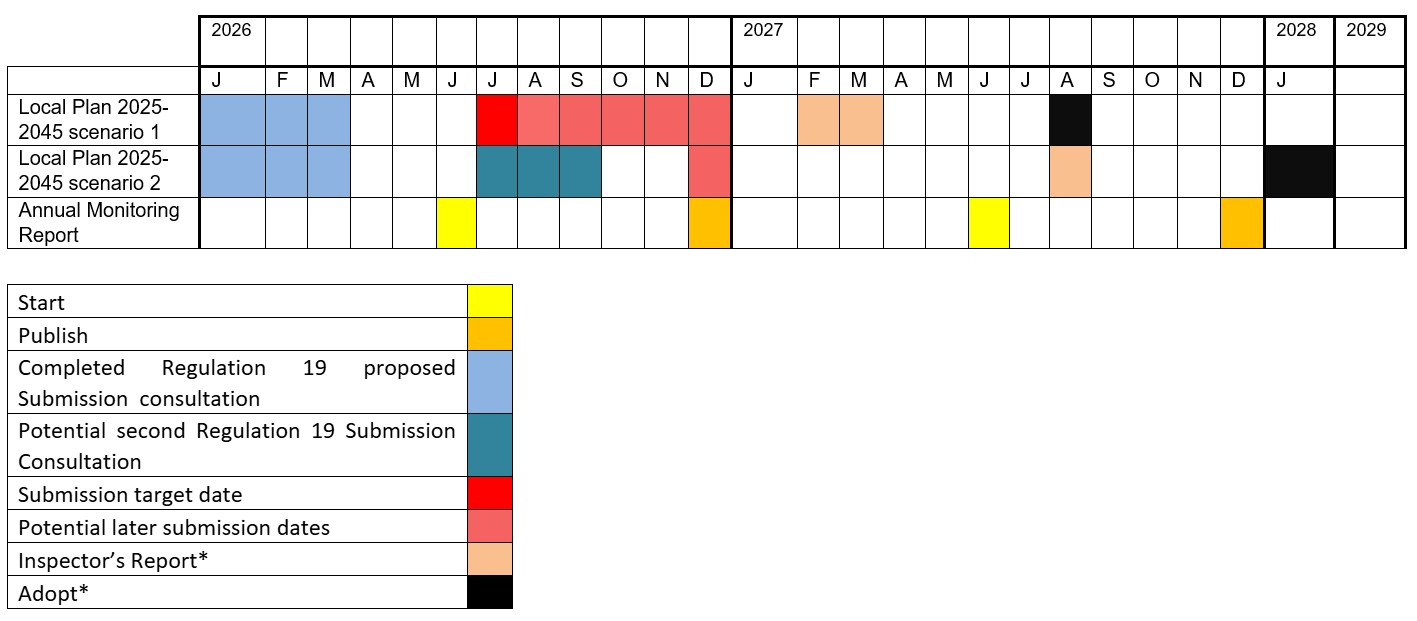 *These are estimates - once the plan is submitted, the timetable is in the hands of the Planning Inspectorate
Plain text version of Gantt chart
Local Plan 2025-45 - scenario 1
- January to March 2026: Completed Regulation 19 proposed Submission consultation
- July 2026: Submission target date
- August to December 2026: Potential later submission dates
- February to March 2027: Inspector's report (This is an estimate - once the plan is submitted, the timetable is in the hands of the Planning Inspectorate)
- August 2027: Adopt (This is an estimate - once the plan is submitted, the timetable is in the hands of the Planning Inspectorate)
Local Plan 2025-45 - scenario 2
- January to March 2026: Completed Regulation 19 proposed Submission consultation
- July to September 2026: Potential second Regulation 19 Submission Consultation
- December 2026: Potential later submission dates
- August 2027: Inspector's report (This is an estimate - once the plan is submitted, the timetable is in the hands of the Planning Inspectorate)
- January 2028: Adopt (This is an estimate - once the plan is submitted, the timetable is in the hands of the Planning Inspectorate)
Annual Monitoring Report
- June 2026: Start
- December 2026: Publish
- June 2027: Start
- December 2027: Publish


