

Giving residents a stronger voice
The Tenant and Leaseholder Board is a resident-led group that works with the Council to help shape housing services.
The Board, made up of 15 residents, represents the views of tenants, leaseholders and shared owners, making sure residents’ voices are heard in decisions that affect their homes, neighbourhoods, and communities.
The Board plays an important role in strengthening accountability, improving services, and ensuring the Council meets its responsibilities as a social landlord.
What does the Board do?
The Tenant and Leaseholder Board:
- Represents residents' views - acts as a collective voice for tenants and leaseholders, raising issues, concerns, and ideas on their behalf
- Influences decisions - provides resident insight and challenge on housing policies, service changes, and priorities before key decisions are made
- Supports service improvement - works with council officers to review how housing services are delivered and suggests improvements based on lived experience
- Monitors performance - looks at housing performance information, including Tenant Satisfaction Measures (TSMs), and helps the Council understand what the data means for residents
- Strengthens accountability - helps make sure the Council is open, transparent, and responsive to residents’ feedback
Who is the Board for?
The Board represents:
- council tenants
- leaseholders
- shared owners
Members bring a wide range of experiences and backgrounds, making sure different communities and housing needs are reflected.
How does the Board work?
The Board meets regularly throughout the year.
Meetings are supported by council officers but led by residents.
Members receive information, training, and support to help them take part confidently.
The Board links with other resident groups and forums to gather wider views.
The Housing Governance structure is shown in the following diagram:
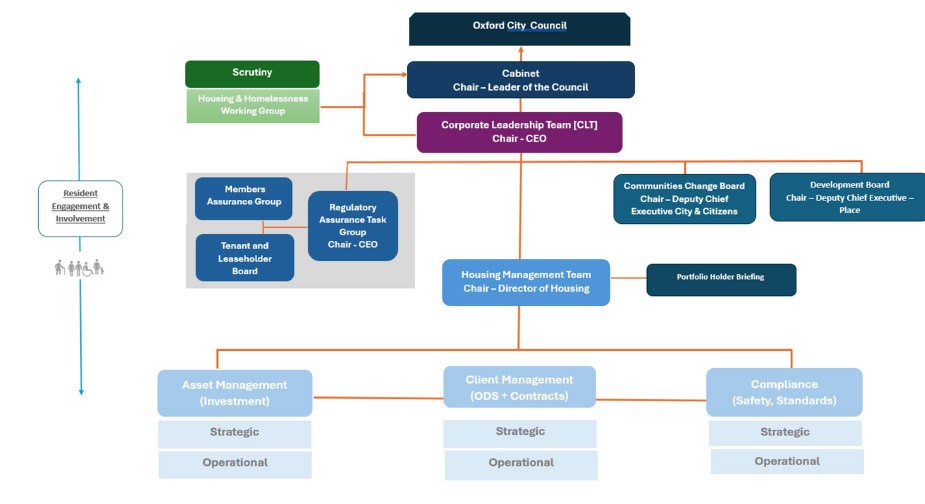
Plain text version of Housing Governance Structure diagram
The chart shows the housing governance structure for Oxford City Council as a hierarchical flow.
At the top sits Oxford City Council, followed by the Cabinet, chaired by the Leader of the Council. Beneath Cabinet is the Corporate Leadership Team (CLT), chaired by the Chief Executive.
Branching from this level are the Communities Change Board and the Development Board and a Scrutiny function, alongside the Housing and Homelessness Working Group.
Below this sits the Housing Management Team, chaired by the Director of Housing. This team connects to a Portfolio Holder briefing and works alongside assurance and tenant-focused groups, including the Members Assurance Group, Regulatory Assurance Task Group, and Tenant and Leaseholder Board.
The structure then divides into three core service areas:
- Asset Management (Investment)
- Client Management (ODS and Contracts)
- Compliance (Safety and Standards)
Each of these areas operates at both strategic and operational levels.
Resident Engagement and Involvement is shown alongside the structure, providing input across all levels of governance.
Why is the Board important?
Strong resident involvement helps the Council:
- ensure that the resident voice is heard in the decision making on the development of housing services
- meet regulatory requirements under the Social Housing (Regulation) Act 2023
- design services based on what residents need, to improve their experience of housing services
- build trust and stronger relationships with residents and communities by improving how we involve, engage, and communicate with people
For residents, the Board offers a meaningful way to influence change and be part of shaping the future of housing services.
If you are a tenant, shared owner or leaseholder and want to help make a difference, there are different ways to get involved, from sharing feedback to becoming a Board member.
Join Resident Involvement
Resident Involvement is about having your say. If you want to take part, use our simple webform (or send an email) and we'll get back to you.
Join Resident Involvement (online form)

