

Contents
- Executive Summary
- Introduction
- Purpose of this Strategy
- A Changing Landscape
- Engagement and Involvement - the Challenges
- Our Plans for Re-setting Engagement and Involvement
- Delivering Our Priorities
Foreword
Councillor Linda Smith - Cabinet Lead Member for Housing
I am pleased to introduce this new Resident Involvement and Engagement Strategy 2025-2028 which has been jointly prepared in collaboration with our residents and key stakeholders. This new strategy sets out our renewed approach and strengthens our commitment to resident involvement and engagement as an essential aspect of our housing service delivery.
This is a time for radical change in how we involve and engage with our residents and how we are transforming our landlord service to deliver better outcomes for our residents. From our engagement with our residents, we know they face their own challenges managing their homes, but they also want assurance that we are a compliant landlord, keeping them safe and one that listens and acts on their concerns. All this has meant that the breadth and variety of their needs have expanded and indeed their reasons and need for wanting to better engage with us – and we must rise and respond to this challenge. This strategy therefore reflects our overarching five key priorities and actions that we intend to deliver jointly with our residents over the next three years.
I commend this Resident Involvement and Engagement Strategy which marks a significant milestone in our transformation housing journey. I encourage our residents and key stakeholders to continue to engage and work with us in our commitment to co- creating a future that puts residents at the heart of our service delivery.
Brenda Walton and Ashad Ali, Residents and Co-design Group Members
As tenants and leaseholders, many of us have grown up and brought up our families here in Oxford and we are proud of where we live and our neighbourhoods.
Many of us have also participated and have been part of Tenant Involvement Groups for many years working hard to improve the living standards of our homes and the areas where we live.
Whilst we acknowledge that this has not always been easy and at times, we have felt that our voices were not being heard with decisions being made about us and our homes without us – this needs to change.
However, the Oxford City Council housing service is at a turning point – prompted by more robust housing legislation and a commitment to change to improve how it engages and involves residents in the delivery of their services.
This presents an excellent opportunity for us as residents to claim our seat at the table, influence and have our voices heard.
Thanks to co-design groups, forums, and good old conversations, we can finally help shape real change. We are convinced that if more of us join in, we will make a difference, ensure our homes are safe and we will build places where everyone feels respected, supported, and heard.
We commend this strategy and call on our fellow residents to feel empowered, join us in this journey so we can influence, and shape engagement plans that best meets our resident needs.
1. Executive Summary
Oxford City Council - Resident Involvement and Engagement Strategy 2025–2028
Oxford City Council (OCC) housing service manages over 8,000 social housing properties, serving approximately 24,000 residents. This strategy outlines a transformative approach to resident involvement and engagement, driven by regulatory standards, local priorities and direct feedback from tenants, leaseholders and shared owners.
Based on what residents have told us, the strategy aims to reset relationships with residents by embedding meaningful engagement, improving service delivery, fostering trust and transparency. It is built on four principles:
- Delivering the promise to reset involvement, engagement and resident relationships
- Actively listen to our residents
- Respond to residents' priorities and their concerns
- Embed meaningful and effective involvement and engagement across our organisation
This strategy also highlights the efforts that will be taken through the 'Knowing Our Residents' programme which involves deploying a more tailored outreach approach and co-designed platforms for formal and informal participation to help us know and understand residents better. Within this, it has helped us to also shape our vision for our residents:
“We will work to enable every opportunity for residents to engage with us in ways that suit them, delivering meaningful and outcome- focused resident involvement where they can influence, scrutinise and shape the delivery of the services they receive”
Our vision encapsulates the involvement and engagement work we have done so far, what we know of our residents and more importantly reflects what they have told us. It has also enabled a sound platform from which we developed our 5 strategic priorities that signal our direction of travel for the next 3 years:
- Establishing foundations for involvement and engagement
- Enhancing resident knowledge to improve service delivery
- Co-designing inclusive involvement and engagement platforms
- Improving communication for respectful, inclusive involvement and engagement
- Delivering high-quality landlord services aligned with resident expectations
To ensure implementation and delivery of our strategic priorities an action plan has been attached to this strategy [see Appendix A]. The action plan aims to provide a more granular insight as to the key actions that will need to be taken forward in order to realise our vision for residents.
The strategy also sets out the arrangements and resources that will be provided for staff and residents, to ensure that both feel empowered, have the tools and the right levels of support to carry out their roles effectively. We are committed to realising real change and we will involve, engage, and work with our residents throughout this transformative involvement and engagement journey.
The proof of our success will be measured and should be seen in the outcomes we expect to see such as increase in satisfaction levels, participation rates from across all of our diverse resident community, and greater transparent reporting and communication that will help to build trust and strong partnerships with our residents.
2. Introduction
Oxford City Council is a landlord managing a substantial social housing portfolio, comprising over 8,000 properties. These homes provide accommodation to approximately 24,000 residents across the city. This extensive housing provision plays a vital role in supporting the diverse needs of our local communities and is central to the Council’s commitment to providing safe, secure, and high-quality housing for all tenants, leaseholders and shared owners.
Driving Radical Change in Resident Involvement and Engagement
This is a time for radical change in how we deliver our landlord services to tenants, leaseholders and shared owners. This momentum for transformation is driven not only by the introduction of a refreshed regulatory regime from the
Social Housing Regulator but also by a clear acknowledgment that improvements must be made in how we involve and engage with our residents. We recognise the need to modernise our approaches to involvement and engagement, ensuring that tenants, leaseholders and shared owners, who directly experience our services, are genuinely involved in shaping how those services are provided.
The proposals and action plan outlined in this strategy form part of a wider comprehensive suite of transformation changes taking place throughout our landlord service. Collectively, these changes will enable us to be better structured and thoroughly prepared to achieve our reset involvement and engagement goals.
Central to our approach is the ambition to reset and establish new, effective ways of involving, engaging and working with our residents. This involves developing the right engagement platforms, the right tools and the right information, offering the support and training necessary for residents to feel empowered and enable them to participate fully. By equipping them with the appropriate tools and support, we aim to foster more effective and meaningful involvement and engagement.
3. Purpose of this strategy
Our transformation journey is already underway, and this strategy sets out our plans for realising this vision. It details the specific changes and service improvements we intend to pursue, ensuring that our commitment to better involvement and engagement and service delivery is at the heart of everything we do. Our strategy commitments are based on four key principles: -
- Delivering our promise: resetting resident relationships
- Emphasising and listening to our residents
- Responding to residents' priorities
- Embedding platforms for meaningful and effective involvement and engagement
Our focus is on transforming and enhancing both engagement and involvement, ensuring residents play a central role in the direction of our housing services.
Listening to the lived experiences and perspectives of our residents is more crucial now than ever before. By giving prominence to the voices of our residents, this strategy provides a framework for implementing significant and lasting changes in how we seek to change and engage with our communities.
A core aspect of our strategy has been the feedback and priorities that our residents have shared with us to date.
This feedback has directly informed our strategic priorities for putting in place involvement and engagement platforms that are accessible and encourage active participation. Through these platforms, residents will have meaningful opportunities to shape, improve, and scrutinise the delivery of our housing services.
Alongside these improvements, this strategy introduces revised involvement and engagement practices founded on the principles of mutual respect, trust, accountability, and transparency.
These values will underpin all interactions, ensuring that involvement and engagement is not only effective but also embedded across services and genuinely collaborative.
4. A changing housing landscape
The national context
Oxford City Council’s responsibilities as a social landlord are framed and defined by a comprehensive framework of legislation, regulations, and standards established by Central Government. This evolving regulatory environment places greater emphasis on increased oversight, the introduction of updated consumer standards, and a stronger focus on tenant satisfaction and feedback.
The Social Housing Act 2023 introduces significant reforms, setting out clear expectations for social landlords:
Social Housing White Paper 2020 and Social Housing (Regulation) Act 2023: The Charter for Social Housing Residents, was released in November 2020.
It outlined that every social housing resident should be able to expect:
- To be safe in your home
- To have your voice heard by your landlord
- To know how your landlord is performing
- To have a good quality home and neighbourhood to live in
- To have your complaints dealt with promptly and fairly
- To be treated with respect
- To be supported to take your first step into ownership
Consumer Standards: Landlords are required to comply with more rigorous updated Consumer Standards, ensuring that tenants are provided with safe, high- quality housing and responsive services.
- The Safety and Quality Standard which requires landlords to provide safe and good-quality homes for their tenants, along with good-quality landlord services.
- The Transparency, Influence and Accountability Standard which requires landlords to be open with tenants and treat them with fairness and respect so they can access services, raise concerns, when necessary, influence decision making and hold their landlord to account.
- The Neighbourhood and Community Standard which requires landlords to engage with other relevant parties so that tenants can live in safe and well- maintained neighbourhoods and feel safe in their homes.
- The Tenancy Standard which sets requirements for the fair allocation and letting of homes, as well as requirements for how tenancies are managed by landlords
Tenant Satisfaction Measures: These measures are now central to how councils are evaluated, highlighting the critical importance of engaging with residents and actively seeking their feedback. TSMs signify a shift in approach, recognising residents as active participants who help shape the services tut hey receive rather than passive recipients.
Our local context and housing priorities
There are several local key strategies that have been considered during the development of this strategy. These set our priorities for housing, focusing our efforts to ensure that we:
- ensure the provision of good landlord services and that we continue to invest to meet housing needs
- ensure our tenants have more say in the way their homes and communities are managed, better support for tenants to sustain their properties and prevent homelessness
- build on the foundations of providing strong social connections, embrace diversity and deliver active community involvement, by promoting opportunities for better cohesion, tackle anti-social behaviour, domestic abuse by working jointly with our community partners
Our strategies:
- Oxford City Council Corporate Strategy 2024-28
- Oxford City Council Housing, Homelessness and Rough Sleeping Strategy 2023-28
- Thriving Communities Strategy 2023-27
- Citizen Experience Strategy 2025-27
Collectively, these changes are designed to drive continuous improvement in social housing, holding the council as a landlord accountable for its performance and ensuring that the voices of residents remain at the heart of decision-making.
5. Involvement and Engagement - the challenges
Building trust and empowerment
We acknowledge that the relationship between the council as a landlord and residents goes beyond than just bricks and mortar. Building good communication, trust and being accountable are also key factors that need to be part of the resident/landlord relationship. Spurred not only by updated Social Housing regulatory changes, but also greater public scrutiny and rising resident expectations, earlier this year we embarked on a series of engagement events where a deeper conversation with residents emerged.
Over 400 residents participated and highlighted a series of issues they were encountering within their property, as well as issues within their neighbourhood.
At its core, it was acknowledged that these issues were not about any one specific problem but about the relationship between the council as a landlord and residents. Taking this on board, we have also considered our Tenant Satisfaction Survey told which told us that only 64% of tenants feel that the Council listens to their views and acts upon them.
From this, we are clear that we need to do better about reinforcing the fundamentals of what it means to be a good landlord and the value of actively listening to our residents.
- Building trust through active listening - Rebuilding trust with residents starte by actively listening to their perspectives, which strengthens relationships and restores confidence in the council's role as a landlord
- Empowering residents in decision-making - Prioritising resident involvement in decisions about services gives them more ownership and ensures their needs are reflected in outcomes
- Understanding residents' needs - Understanding residents' needs allows the council to tailor services more effectively and improve satisfaction by using their feedback to guide improvements
What this means in practice is that we need to work at building and gaining our residents trust, understand their needs and empower them by better involving them in decisions that will impact on the quality of services they receive.
Overall, we understand that our residents want to be actively heard and in doing this we will be laying the groundwork for them to feel valued and empowered.
Our involvement and engagement work must also ensure it is embedded across service delivery. This not only also provides us with the opportunity to demonstrate that we are listening but to evidence that their voice helps to inform and shape delivery of services, that lead to outcomes that genuinely reflect their needs and priorities.
Understanding our residents
Meaningful involvement and engagement that truly reflects the diverse voices including those who are silent or under presented requires a good understanding of who our residents are.
Recognising this, last year, we embarked on a Knowing our residents programme which is helping us to gather data to better understand who our residents are, what their needs are and for some their vulnerabilities. We will use our intelligence and data to identify patterns that help prioritise service improvements so that residents can see that their input leads to tangible improvements and that their voice is heard.
- 20,400 - There are approximately 20,400 residents living in council housing
- 60% - Approximately 60% of our residents are from white background
- 40% - Approximately 40% of residents are from other backgrounds - Black, Asian and Irish
- 50% - Approximately 50% of our residents are over 55 and older
- 5% - Approximately 5% have some tye of disability
Gaining a better understanding of our residents is and will continue to assist us in designing engagement opportunities that are accessible and inclusive for our different groups and residents’ needs.
To facilitate this, we will continue with our efforts of exploring different involvement and engagement approaches that better meet residents’ needs – such as more hybrid and in person meetings in community settings to maximise accessibility as this is what our residents have also told us that they want to see.
Taking on board the diversity, mobility limitations of some of our residents – we will work to better support them to engage and get involved in ways that better meets their needs, for example, removing language barriers by providing interpreting service where this is possible and holding meetings in locations where it better enables them to attend.
We will remain committed to responding to individual requirements and will plan to support residents’ involvement whenever possible.
Understanding their priorities
In addition to the areas that residents told us were important to them, the series of engagement events provided us with a deeper understanding of what our residents expect from us as their landlord. These sessions allowed residents to share practical suggestions for improvement, focusing on how we can make involvement more accessible, inclusive, and, above all, genuinely meaningful.
Through these conversations, residents identified their top ten priorities. These priorities reflect both what matters most to them and the changes they believe will have the greatest positive impact:
- Resident safety - Residents want to be and feel assured of their safety where they live
- Better resident engagement - Residents want to have more in person, meaningful, responsive engagement that is embedded across services
- Better communication - Residents want better and more accessible information provided to them about their services
- Better handling of complaints - Residents want to understand the complaints handling process and see improvements in performance
- Better repairs service - Residents want to see improvements in repairs and contractor management and information on performance
- A landlord service offer - Residents want to see a clear landlord service offer that sets out standards or service
- Visible / accessible housing service - Residents want to see Housing Officers on the ground (in person) and more accessible, and treated with respect
- Consistent service delivery - Residents want to see consistency in standards of service delivery, less staff turnover and greated service resilience
- Accessible policies and processes - Residents want to have influence and access to housing policies and procedures
- Training and support - Residents want to be provided with training, funding and performance information to enable them to be effective in their engaement roles and feel empowered
We have considered our resident priorities and these form the cornerstone of this strategy and is guiding our actions and decisions as we move forward. The dialogue and collaborative co-working with residents has been instrumental in shaping our approach.
Our dialogue with residents will continue ensuring that every household’s unique perspective and lived experience is valued and considered as far as possible.
This commitment underpins our dedication to embedding resident involvement and engagement across all our services, ensuring that the voice of each resident is actively heard and influences the way we deliver landlord services.
6. Our plans for resetting involvement and engagement
To ensure that involvement and engagement with our residents is both meaningful and impactful, we are focusing on strengthening the foundations of our approach. We recognise the importance of building trust, understanding residents’ needs, and empowering them by involving them more actively in decisions affecting the quality of services they receive.
This ongoing commitment will help us ensure that every resident’s voice is heard, valued, and acted upon.
Our resident involvement and engagement offer
To deliver on our strategic objectives and realise our vision, we have actively worked alongside residents throughout the design process. Together, with our co-design group we have developed an indicative model of involvement and engagement that we will look to agree via the implementation of this strategy. The core aim is to provide a variety of platforms that can cater to the diverse needs and preferences of our residents.
This model encompasses both ‘formal’ council-wide structures and more ‘informal’ local, one-off opportunities. We expect that the formal mechanisms will enable residents to participate in structured, ongoing involvement at a city level, ensuring their voices contribute to major decisions and policy development. In contrast, informal opportunities are set out to be more accessible and flexible, allowing residents to engage on an ad hoc basis within their local communities when it suits them best.
By offering a range of engagement options, our approach ensures that all residents, regardless of their level of interest or availability, have meaningful opportunities to have their say and influence the services they receive. This dual approach underpins our commitment to fostering a genuinely inclusive and responsive resident involvement and engagement culture.
Our resident involvement and engagement offer diagram
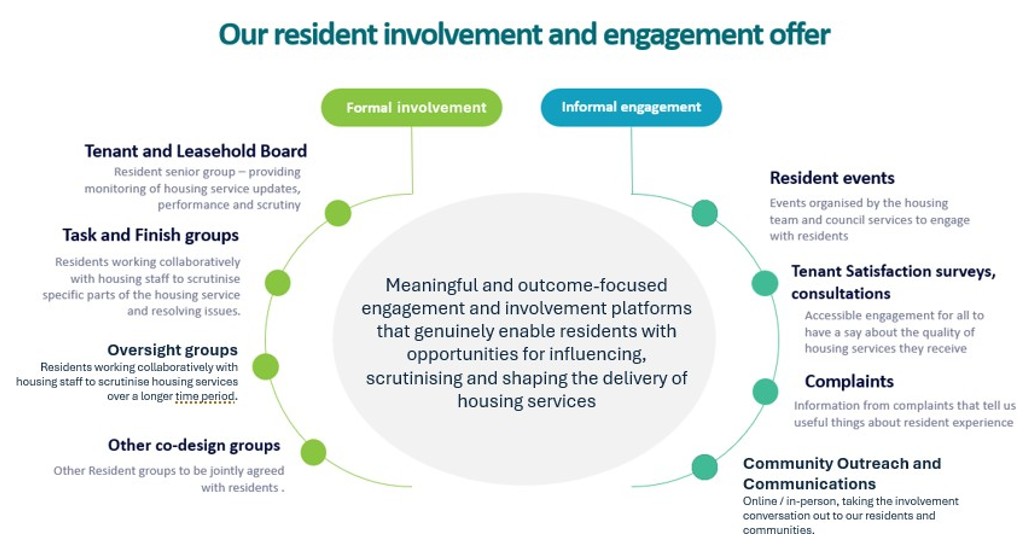
Plain text version of Our resident involvement and engagement offer diagram
Meaningful and outcome-focused engagement and involvement platforms that genuinely enable residents with opportunities for influencing, scrutinising and shaping the delivery of housing services.
Formal involvement
- Tenant and Leaseholder Board - Resident senior group - providing monitorng of housing service updates, performance and scrutiny
- Task and Finish groups - Residents working collaboratively with housing staff to scrutinise specific parts of the housing service and resolving issues
- Oversight groups - Residents working collaboratively with housing staff to scrutinise housing services over a longer time period
- Other co-design groups - Other resident groups to be jointly agreed with residents
Informal involvement
- Resident events - Events organised by the housing team and council services to engage with residents
- Tenant Satisfaction surveys, consultations - Accessible engagement for all to have a say about the quality of housing services they receive
- Complaints - Information from complaints that tell us useful things about resident experience
- Community Outreach and Communications - Online - in-person, taking the involvement conversation out to our residents and communities
We expect that our strategic objectives and involvement/engagement offer combined, these will result in establishing solid foundations for residents to be more informed and involved, ensuring that service improvements are genuinely reflective of their priorities, and foster a culture of trust and collaboration. Ultimately, our aim is for every resident to feel their voice is heard and to see real, positive changes in the quality and responsiveness of the services they receive
Our vision
In moving forward with our strategy, we want to create a range of platforms, opportunities and choices for residents to get involved and engage. With the feedback we have gathered so far, we are in a better place to set our vision and strategic priorities that we will seek to deliver over the next three years. As we deliver this strategy – our conversation with our residents will also continue so we can work together ensuring that our involvement and engagement is effective and improvements are meaningful for our residents.
Our vision for our residents
"We will work to enable every opportunity for residents to engage with us in ways that suit them, delivering meaningful and outcome- focused resident involvement where they can influence, scrutinise and shape the delivery of the services they receive"
Our vision encapsulates the work that has been done so far and more importantly it reflects what our residents have told us about the behaviours they expect from us and their service priorities. Within this, we have therefore set out our five priorities that signal our direction of travel for the next three years:
- Priority 1: Establish and embed the right foundations and culture for meaningful resident engagement and involvement
- Priority 2: Establish meaningful resident involvement and engagement platforms that are representative and inclusive of our resident community
- Priority 3: Develop our knowledge about our residents to deliver services that better meets their needs
- Priority 4: Review and strenghthen our communication with residents to foster respectful engagement that is inclusive and in ways that meets residents needs
- Priority 5: Deliver high quality landlord services to residents ensuring these exhibit the right behaviours and outcomes for residents
7. Delivering our priorities and action plan
To deliver our priorities and action plan, we will implement a series of tangible actions focused on making involvement and engagement accessible and impactful for all. These actions are specifically targeted at removing barriers to participation and maximising the impact of involvement and engagement across our services.
The priorities and action plan are included in Appendix A within this strategy - each take on board the feedback we have received from our residents and key stakeholders. By following this structured plan, we aim to embed resident involvement and engagement at the heart of our service delivery across services, ensuring that all voices are heard and that improvements are genuinely shaped by those who use our services.
Supporting our residents and staff to deliver
The journey towards resetting resident involvement and engagement has already begun, and this strategy sets out the programme of improvements that we intend to deliver. To deliver this strategy, we must also ensure that we have the right resources.
Our dedicated Resident Involvement Team will help to co-ordinate involvement and engagement activities and support service teams with practical support.
We will ensure that the team is supported and provided with the right tools, training and support to carry out their roles effectively. The team will also be responsible for working with resident groups to assess the success of this strategy. Where appropriate, the council will also consider the provision of other resources such as financial and all other associated costs to secure delivery of our objectives.
We also recognise that, to ensure meaningful and effective resident involvement, we will need to provide our residents with appropriate support.
This includes offering training opportunities specifically designed to equip them with the knowledge and skills required to carry out their representative and scrutiny roles effectively.
We are confident that by providing this support, we will empower our residents to participate confidently, ensuring that their contributions have a real impact on the decisions and improvements that affect their homes and local areas.
Assessing impact and delivery
To assess the positive impact of our resident involvement and engagement strategy, we will frame our evaluation the following actions:
- We will track the outcomes of involvement and engagement activities against our strategic objectives, identifying areas where resident feedback has directly contributed to tangible improvements
- We will track participation rates, monitor the diversity of those involved, and measure the extent to which resident input has influenced service delivery and decision-making processes.
- We will regularly ask residents, staff, and others for their views and use insight data to help us understand what is working well and what could be improved
Monitoring and communicating our achievements
- We will provide and publish the outcomes that this strategy is achieving for our residents and the positive outcomes it is delivering for them
- We will demonstrate how we are actively working to ensure involvement and engagement and representation from our vulnerable and diverse resident groups
- We will evidence the positive changes in service quality, resident satisfaction, and trust as a direct result of our involvement and engagement efforts.
In conclusion, we want to make sure residents are really involved in making decisions about their communities. By offering help and training, checking how well we are doing, and clearly sharing our results, we hope residents will feel welcome and confident to join us in this transformation journey.
Appendix A - Resident Involvement and Engagement Strategic Priorities Action Plan
Priority 1: Establish and embed the right foundations and culture for meaningful resident involvement and engagement
| Reference | Action | Key lead | By |
|---|---|---|---|
| 1 | Deliver a member and cross-service internal training aimed at raising awareness of the updated regulatory framework in particular the requirements of the Transparency, Influence and Accountability consumer standard | Members, CLT, Housing | Q4 2025/26 |
| 2 | Develop and establish housing service policies, procedures that are accessible to residents and that they clearly reflect the service level offer that residents can expect and that have been subject to resident review | Housing, Cross services | Q2 2026/27 |
| 3 | Ensure Tenant Satisfaction Measures (TSMs) results are effectively captured and used to improve and help shape delivery of housing services and evidenced to residents | Housing, Cross services | From Q1 to Q4 2026/27 |
| 4 | Develop and agree a performance management framework that is shared with residents and clearly informs quality of delivery of services – including assurance on safety related matters | Housing, Cross Services | Q2 2026/27 |
| 5 | Develop and ensure that outcomes arising from the new Resident Involvement and Engagement strategy are shared and communicated internally to members, CLT and service managers and residents | Housing, Cross Services | From Q1 2026/27 |
Priority 2: Establish meaningful resident involvement and engagement platforms that are representative and inclusive of our resident community
| Reference | Action | Lead | By |
|---|---|---|---|
| 6 | Establish meaningful involvement and engagement platforms that enable residents to hold the council to account for the quality of services received, the performance and decisions made on their behalf | Housing/ Landlord Services and Residents | From Q42025/26 to Q2 2026/27 |
| 7 | Plan and provide training and support to residents to ensure they are equipped with the necessary skills and knowledge to effectively performance manage, scrutinise and contribute to the improvement and efficient delivery of housing services to residents | Housing/ Landlord Services and Residents | From Q4 2025/26 |
| 8 | Develop and establish an inclusive approach to ensure a better balance in opportunities, resources, and decision-making processes for the diverse resident community to build better relationships and collaboration | Housing/ Landlord services and Residents | From Q1 to Q3 2026/27 |
| 9 | Proactively encourage a diversity of views and experiences, across estates to understand variations and ensure that the voice of all residents is listened and acted on as far as possible | Housing/ Landlord Services and Residents |
From Q4 2025/26 to Q3 2026/27 |
| 10 | Through Area Based working, provide support and sustainment to residents in need - to enable them to maintain their tenancies and foster an environment that reflets inclusivity and overall well-being of residents | Housing/ Landlord Services and Residents |
Q4 2025/26 |
Priority 3: Develop our knowledge about our residents to deliver services that better meets their needs
| Reference | Action | Lead | By |
|---|---|---|---|
| 11 | Complete the “know your resident” project data and information gathering exercise to ensure a better understanding of residents’ profile and their diverse needs | Housing/ Landlord Services | Q1 2026/27 |
| 12 | Ensure all key resident touchpoints form part of wider resident data gathering to ensure that all groups have a fair access to housing and landlord services [e.g. Disability, ethnicity, language etc.] | Housing/ Landlord Services | Q4 2025/26 |
| 13 | Develop and establish a better, smarter, data focused approach to resident service improvement/design/delivery - using data as a key tool to deliver meaningful actions and better outcomes for residents | Housing/ Landlord Services | Q2 2026/27 |
| 14 | Internally build capacity to interpreting and utilising data, fostering a shared understanding of how resident data can inform strategic decisions for the benefit of the residents and their neighbourhoods | Corporate/ Housing/ Cross services | Q1 2026/27 |
| 15 | Better align property condition data with resident data [for e.g. those who live in homes with damp and mould, in need of adaptations] ensuring “those homes” are effectively linked, to enable better understanding and addressing inequalities | Housing/ Landlord Service and Property Services |
Q4 2025/26 |
Priority 4: Review and strengthen our communication with residents to foster respectful involvement and engagement that is inclusive and in ways that meets residents needs
| Reference | Action | Lead | By |
|---|---|---|---|
| 16 | Review council housing website content with a view to ensure that the right and accessible information is available to residents and provide them with better quality information about their homes and their neighbourhoods | Housing/ Landlord Services | Q1 2026/27 |
| 17 | Further develop a range of communication channels for residents - e.g. phone calls, emails, text messages and social media to accommodate their different communication and engagement preferences as far as possible to gather their feedback | Housing/ Landlord Services | From Q1 2026/27 |
| 18 | Alongside residents, review existing communication channels for residents with a view to improving, modernising and exploring new channels that better meet residents’ needs, and that makes information more accessible and engaging | Housing/ Landlord Services | Q1 2026/27 |
| 19 | Develop and publish a resident communication plan that seeks to build trust, transparency with residents and encourages them to proactively participate in improving housing service delivery and decisions-making processes | Housing/ Landlord Services | Q1 2026/27 |
| 20 | Embed proactive and transparent involvement and engagement by regularly updating residents on issues that matter to them including policy changes, changes in service delivery and related matters in order to build trust and awareness | Housing/ Landlord Services | Q1 2026/27 |
Priority 5: Deliver high quality landlord services to residents ensuring these exhibit the right behaviours and outcomes for residents
| Reference | Action | Lead | By |
|---|---|---|---|
| 21 | Provide resident further assurance complaint panel, by that establishing an effective complaint handling process is provided that is compliant, accessible and that it embraces complaints as an opportunity to improve services for residents | Corporate/ Landlord Services | Q1 2026/27 |
| 22 | Ensure compliance with landlord responsibilities for tenancy safety to assure tenants of their safety and that they have an opportunity to have a say on performance in this area | Housing/ Property Services | Ongoing |
| 23 | Action the findings of the independent repairs review to ensure that residents receive an improved repairs service delivered by a skilled call centre service, and an improved reporting process and better insight of performance | Housing/ Property Services | Q4 2025/26 |
| 24 | Put in place arrangements for proactive engagement with residents on the planning and decision making of investment plans that will impact on their homes and their neighbourhood | Housing/ Property Services | All planning stages |
| 25 | In line with the landlord service re-organisation and Competency and Conduct Consumer Standard - ensure that Housing Officers receive training and skill-up to deliver good quality housing services and that they exhibit the necessary and right behaviours to tenants and leaseholders, and in due course, extend to the wider landlord function | Housing/ Landlord Services | From Q4 2025/26 |


