

Contents
- Purpose
- Background
- Scope
- Definitions
- Categories of works
- Exceptional Circumstances
- Options for support and assistance
- Access Injunction process
- Monitoring and Review
- Equality, Diversity and Inclusion
Purpose
1.1. To ensure that Council residential properties are well maintained and meet the Government’s Decent Homes Standard as a minimum by working with tenants to prevent the refusal / no access of programmed improvement works, planned maintenance, certain repairs and surveys required, such as stock condition surveys.
1.2. To ensure the Council deliver works that will contribute to the Council’s 2040 Zero Carbon Target.
1.3. To enable the annual capital works programme and other related workstreams to be delivered as planned.
1.4. To ensure compliance with legal, Health and Safety regulations and compliance with tenancy agreements. In addition, this policy ensures that the early intervention of safeguarding concerns can be identified.
1.5. To provide a set of guidelines, including a range of options to act as a framework for officers to support tenants to enable works to be completed.
1.6. To ensure a robust escalation process is in place to provide the tenant with the opportunity to give access at a mutually convenient time whilst advising that it may lead to legal action such as an access injunction where no access is provided.
1.7. To outline what can and cannot be refused, identify valid and acceptable reasons for refusal and provide a set of actions to be followed by officers to enable successful court proceedings such as access injunctions followed by committal proceedings or claim for possession where there is a refusal of essential work.
1.8. Our aim is to provide a service that will:
- Provide high quality housing services and home improvements for secure, warm and sustainable homes.
- Treat our tenants with respect at all times. We will be empathetic and non-judgemental with all tenants, ensuring they are listened to.
- Comply with all property related legislation.
- Work in partnership with tenants for continual service improvement in delivering the annual capital works programme
Background
2.1. Potential risks resulting from refusals / no access for improvement work include the following:
- Effective delivery of the capital programme and related workstreams, such as significant underspends in the year.
- Value for money – one-off replacements usually cost more, plus may have a longer lead in time compared to a planned approach.
- Health & safety – some elements of work are required from a health and safety perspective
- Safeguarding concerns – The need for these concerns to be identified.
2.2. Tenancy agreements state that tenants must allow access to inspect and carry out repairs and improvements, and that if a tenant does not allow access that we could take legal action, with the tenant having to potentially pay the costs. When a tenant refuses work or allow access, they are effectively in breach of their covenants in the tenancy agreement.
Scope
3.1. This policy covers all Council owned residential properties, and leasehold and shared ownership stock.
3.2. This policy applies to all programmed capital improvement works (including planned maintenance, repairs and surveys).
3.3. This policy applies to servicing, where the Council are legally required to carry out safety checks for instance compliance with the Gas Safety (Installation and Use) Regulations 1998.
3.4. This policy applies to any property inspections carried out, in order to ascertain the condition of the property.
Definitions
- Decent Homes Standard - A standard set by Government to ensure social housing is in a decent state of repair and has a reasonable level of modern facilities and thermal comfort.
- Refusal - Tenant declines home improvement/s and repairs to the Council property they live in and sign a waiver for the works.
- Omission - It is found that the improvement work is no longer required e.g., the kitchen is newer than was expected; due to the repairs service having already completed the work required as a repair; the property has benefitted from a disabled adaptation; or the tenant has completed the work at their own expense subject to Landlord permission.
- No Access - Despite numerous attempts to communicate with the tenant, including letters, phone calls, home visits etc. No contact made with the tenant.
Categories of works
5.1. With the following categories, images would be taken on each visit to assess quality control before, during and after works.
| Type of work, maintenance or survey | Intrusive/non-intrusive | Internal/External | Enforcement Action Required | Comments |
|---|---|---|---|---|
| Windows | Intrusive | External/Internal | Yes | Potential minimal intrusion in colder months. Integral component to fabric of building. Contributes to Decent Homes and Zero carbon targets |
| Doors | Intrusive | External/Internal | Yes | Potential minimal intrusion in colder months. Integral component to fabric of building. Contributes to Decent Homes and Zero carbon targets. May be required due to Fire Risk Assessment |
| Asbestos surveys | Intrusive/Non-intrusive | External/Internal | Yes | Required under Decent Homes Standard legislation and the Health and Safety at Work etc. Act 1974. Tenants may need to be decanted dependent on circumstances |
| Roofs | Non-intrusive/Intrusive | External | Yes | Potential minimal intrusion if items stored in loft or disruption to garden and or parking. Integral component to fabric of building. Contributes to Decent Homes target |
| Structural work | Intrusive | External/Internal | Yes | Integral component to fabric of building, may impact other properties if not carried out |
| External painting | Non-intrusive | External | No | Cyclical painting of fascia’s / gutters, fences etc. May extend life of those components plus benefits general appearance of property |
| Kitchen | Intrusive | Internal | No | Intrusive in one room plus storage required for kitchen items elsewhere. Potential disruption to essential services. Contributes to Decent Homes target. |
| Bathroom | Intrusive | Internal | No | Intrusive in one room. Potential disruption to essential services. Contributes to Decent Homes target |
| Rewire | Intrusive | Internal | Yes | Very intrusive, all areas of home affected. Potential disruption to essential services. Contributes to Decent Homes target. |
| Boiler replacement and central heating (with renewable heating) | Intrusive | Internal | Yes | Very intrusive (if central heating included), all areas of home affected. Potential disruption to essential services. Contributes to Decent Homes target and zero carbon target. |
| Insulation (External Wall) | Non-intrusive | External | Yes | Contributes to zero carbon target |
| Insulation (Internal Wall) | Intrusive | Internal | Yes | Very intrusive to front and rear internal rooms, plus gable if necessary. Contributes to zero carbon target. |
| Sprinklers | Intrusive | Internal | Yes | In connection with fire safety legislation |
| Fire risk assessment work | Dependent on area required | Internal/External | Yes | Work is mandatory to comply with Fire Risk Assessment action requirements. Potential fluctuations in temperature while work is being undertaken. |
| Electrical condition reports | Intrusive | Internal | Yes | Minimal intrusion. Electrical condition reports are mandatory. Potential disruption to essential services. |
| Stock condition survey | Non-intrusive | Internal/External | Yes | To assist Housing Health and Safety Rating System (HHSRS) compliance and assist future investment decisions. Compliance with revised consumer standards set by the Regulator of Social Housing. Potential decanting of tenants if a category one issue or issues has been identified. |
| Repairs | Intrusive/Non intrusive | Internal/External | Yes/No | Where the repair relates to a potential health and safety issue and could have an impact on the integrity of the building or the tenant’s health and safety then enforcement action should be considered. Potential disruption to essential services. |
| Property Audits | Non-intrusive | Internal | Yes | Meter readings, photos etc. Visits and EPCs. Public funding could be at stake if these are not carried out. |
5.2. The list above is not exhaustive and there may be other elements of work which arise in the future, and it will need to be agreed whether enforcement action is taken.
5.3. In certain circumstances, environmental sensors should be fitted in properties to assess the state of the property at any given moment. The use of such technology can be required to maintain safe, healthy homes and demonstrate proactive management. The data collected would be secured under data protection legislation.
Exceptional Circumstances
6.1. The Council may only accept refusals for work in exceptional circumstances and will not allow a tenant to refuse without a valid reason. However, officers will help and support the tenant throughout the works and aim to minimise the inconvenience as far as is possible. Ultimately the Council may take the decision to enforce by way of injunction and committal proceedings, if necessary.
6.2. Some tenants are not in a position to go through the disruption. Some examples include:
- Being medically unfit or going through a prolonged illness
- Having ongoing and / or significant medical treatment
- Having a disability and have no-one to assist them to prepare for the works
- Caring for someone who is terminally ill in the house
- Having recently been discharged from hospital and still recuperating
- Recently having been bereaved
6.3. The list above is not exhaustive and there may be other exceptional circumstances that arise. The Council will take these into account and use discretion as to whether works should commence and will work with and support tenants as necessary.
Options for support and assistance
7.1. In order to keep our stock well maintained and keep refusals to a minimum, the following list of best practice guides and measures has been devised:
- Letter to residents as soon as Capital programme approved and related workstreams detailing plans for their property, the reason for the works, an estimated start date and ways to help them prepare. The letter should also include a reminder of their obligations as a tenant to allow us to carry out repairs / improvements
- The Council will work to arrange appointments which are convenient for tenants and the Council including the use of the Localz app which enables the tracking of contractors to work appointments and allow tenants to provide feedback to the Council
- Surveys undertaken by in house surveyors and external designers/contractors to determine full scope of the works required and discuss any concerns tenants may have about upcoming works
- Point of contact to be issued for all communication prior to and for the duration of the works
- Offer to liaise with family / friends to help where required
- Provision of packing boxes
- Offer of flexibility (for example, if project is going to be on site for a number of weeks, offer of flexibility when works can be programmed)
- Support to pack / move items
- Choices (i.e., chased or surface mounted electrics / pipework), colour choice of component (i.e., door) etc
- Alternative daytime accommodation
- Programming to help residents who may wish to de-clutter prior to the works (where skips are made available for tenants to get rid of items they no longer want)
- Alternative accommodation offered to residents on a case-by-case basis while the internal work is taking place
- Deep clean following work if necessary
Access Injunction process
8.1. Access Injunctions are discretionary remedies and if the tenant opposes the improvements, the Court will need to consider the tenant’s objection, which is likely to result in a trial. The success or otherwise may also depend on the type of improvement and why the work is being carried out.
8.2. The following process would be followed if an access injunction is being considered:
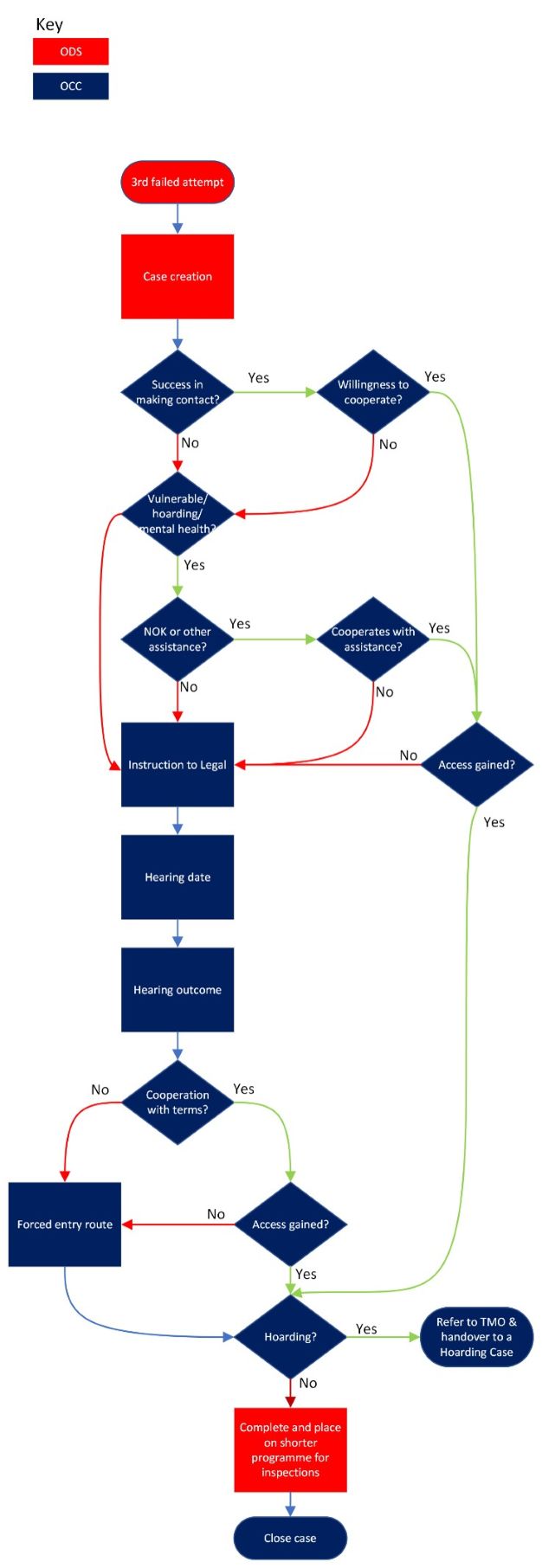
Plain text version of flowchart
3rd failed attempt (responsibility of ODS)
Go to 'Case creation'
Case creation (responsibility of ODS)
Go to 'Success in making contact?'
Success in making contact? (responsibility of OCC)
- If yes, go to 'Willingness to cooperate?'
- If no, go to 'Vulnerable / hoarding / mental health?'
Willingness to cooperate? (responsibility of OCC)
- If yes, go to 'Access gained? (1)'
- If no, go to 'Vulnerable / hoarding / mental health?'
Vulnerable / hoarding / mental health? (responsibility of OCC)
- If yes, go to 'NOK or other assitance?'
- If no, go to 'Instruction to legal'
NOK or other assitance? (responsibility of OCC)
- If yes, go to 'Cooperates with assistance?'
- If no, go to 'Instruction to legal'
Cooperates with assistance? (responsibility of OCC)
- If yes, go to 'Access gained? (1)'
- If no, go to 'Instruction to legal'
Access gained? (1) (responsibility of OCC)
- If yes, go to 'Hoarding?'
- If no, go to 'Instruction to legal'
Instruction to legal (responsibility of OCC)
Go to 'Hearing date'
Hearing date (responsibility of OCC)
Go to 'Hearing outcome'
Hearing outcome (responsibility of OCC)
Go to 'Cooperation with terms?'
Cooperation with terms? (responsibility of OCC)
- If yes, go to 'Access gained? (2)'
- If no, go to 'Forced entry route'
Forced entry route (responsibility of OCC)
Go to 'Hoarding?'
Access gained? (2) (responsibility of OCC)
- If yes, go to 'Hoarding?'
- If no, go to 'Forced entry route'
Hoarding? (responsibility of OCC)
- If yes, go to 'Refer to TMO and hand over to a Hoarding case'
- If no, go to 'Complete and place on shorter programme of inspections'
Refer to TMO and hand over to a Hoarding case (responsibility of OCC)
(End of flowchart)
Complete and place on shorter programme of inspections (responsibility of ODS)
Go to 'Close case'
Close case (responsibility of OCC)
(End of flowchart)
8.3. Where a tenant fails to comply with an injunction to provide access we could seek enforcement of the injunction by contempt of court proceedings , which could result in imprisonment. We will also consider possession proceedings where necessary.
Monitoring and Review
9.1. A comprehensive record of refusals from 2026/27 will be kept utilising the Council database ensuring that retrospective improvements can be made either when the property becomes void or when a new tenant moves in which is in line with GDPR requirements. Where the improvement is omitted from the programme property data is updated to include correct data.
9.2. A comprehensive record of access injunction applications and outcomes will be kept from 2026/27, along with any lessons learned from past access injunction proceedings. The data will be held in accordance with GDPR regulations and the Data Protection Act.
Equality, Diversity and Inclusion
10.1. Equality and diversity affect all aspects of the housing service. As a landlord and an employer, the Council aims to recognise and respond positively to people’s differences, while providing equality of opportunity in relation to the services we provide and support.
10.2. This means that no person or group of people, either working for the Council or seeking housing will be treated less favourably because of their or their partner’s, families, friend’s or associated person’s protected characteristics, which are:
- Age
- Disability
- Gender reassignment
- Marriage and civil partnership
- Pregnancy and maternity
- Race (including race and ethnicity, nationality, immigration status)
- Religion or belief
- Gender and sexual orientation
10.3. The Council recognises the importance of ensuring all our residents have equal access to our services which are relevant, responsive and sensitive to the needs of our existing and future residents.
10.4. The Council, in compliance with the Equality Act 2020, will treat all our residents fairly whilst valuing diversity with the aim to meet the needs and choice of people from all backgrounds.


