

We have created a guide designed to support the boating community in Oxford by promoting sustainable and safe practices, particularly around heating and fuel use, and to improve air quality and protect public health. The guide has been created with our partners - DEFRA, OxonAir and the Canal and River Trust.
Download the full Air quality guidance for Oxford's waterways document.
We have also created a practical step-by-step guide for boat dwellers:
Burn better, breathe better - a practical guide for boat dwellers
Exposure to air pollution can harm anyone’s health at any stage of life. For boat dwellers, the two main pollutants of concern are:
- particulate matter (PM2.5): tiny particles which are mainly released when burning wood, coal or other solid fuels for heating
- nitrogen dioxide (NO2): gas which is produced when burning diesel or petrol primarily in engines and generators
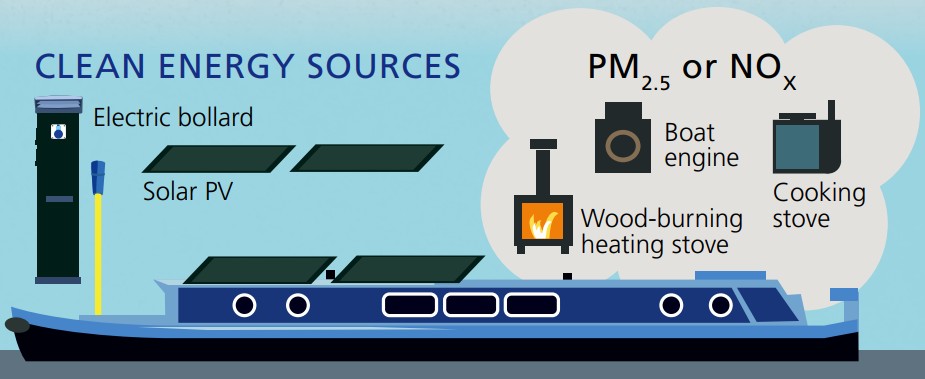
Burning solid fuels emits harmful particulate matter which are so small that you cannot see them and can enter your bloodstream and travel to every organ in the body including the brain, heart, lungs and liver.
The World Health Organization (WHO) states that there is no safe level of air pollution. However, you can protect your health and reduce pollution by burning only Defra-approved fuels in Defra-exempt stoves.
Step 1 - Choosing the right fuel
We advise that you burn smokeless fuel as they have lower levels of volatile compounds and sulphur, leading to less smoke and fewer particulate emissions when burned. They are also more efficient as they burn at higher temperatures, producing more heat with less waste.
If you do burn wood, ensure that wood is dry, seasoned wood with a moisture content of less than 20%. Never burn wet, treated, glued or painted wood as it is by far the most polluting and least efficient fuel to burn!
Step 2 - Lighting the fire
To light the fire:
- lay scrunched up paper or firelighters in the centre of the grate
- arrange kindling in teepee shape on top and light the paper
- once the kindling is burning, gradually increase the size of the log or the amount of smokeless fuel around until the fire is established
Step 3 - Controlling the stove
Open both vents and allow the initial fuel to catch properly. Avoid adding too much fuel too soon which can smother the fire. Once the fire is well established, control the burn rate at your desired temperature. Avoid smouldering the fire, this causes more smoke and pollution.
Step 4 - Refuelling
Slowly open the door and gradually add fuel to avoid smothering and ensure there are sufficient glowing embers before refuelling to prevent excessive smoke.
Using your stove
When using your stove:
- always look for the ‘Ready to Burn’ logo when buying fuel and ensure that wood is dry and has a moisture content of less than 20%
- always use your stove in line with the manufacturer’s guidance
- service your stove and sweep your chimney at least once a year
- make sure that the ventilation system is clean and has no blockages to prevent carbon monoxide build up
Reducing your exposure to air pollution
You can also reduce your exposure to air pollution by:
- opening the boat door and windows when cooking
- closing all windows and doors when running your engine
- stopping the engine and using ropes when operating the lock
- reducing your cruising speed by 10%.
For more information on air pollution and burning advice, visit our Fuel Good Campaign pages.



